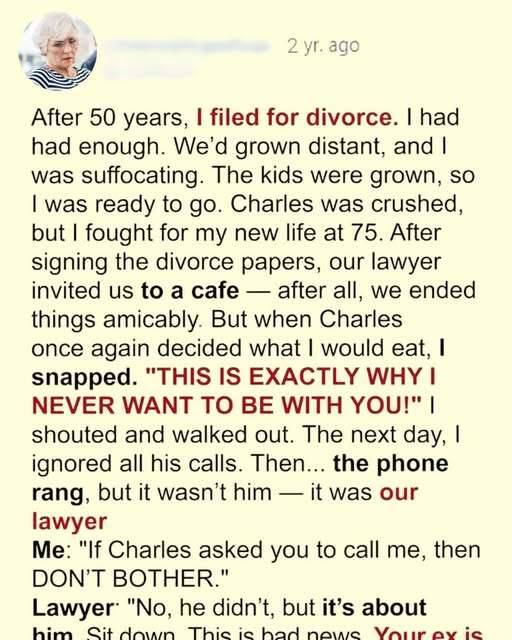
If anyone had told me that at seventy-five years old I’d be the one asking for a divorce after a long-term marriage, I would have laughed. People our age are supposed to be settling into their routines, cherishing whatever time is left, not walking into a lawyer’s office to end a life built over five decades.
But there I was.
I didn’t ask for the divorce because my husband, Charles, had betrayed me. There was no scandal, no affair, no dramatic betrayal. The truth was both simpler and more painful: somewhere between raising children, tending to parents, keeping a home, and smoothing over the rough edges of life, I had misplaced myself.
I had become “us” so completely that I no longer knew “me.”
For fifty years, our marriage had been the center of my world. Our long-term relationship was the anchor for everything: the children, the holidays, the house, the traditions. Yet after we both retired, that same anchor began to feel like a weight tied around my ankles. What once comforted me now felt like a cage I couldn’t quite name.
When Comfort Starts to Feel Like Confinement
We married young. Charles was the kind of man everyone said was perfect “husband material.” Steady. Patient. Dependable. He showed up when he said he would. He listened. He remembered little details.
We built a home filled with warmth and habits. Friday nights meant takeout and an old movie. Sundays meant church, then family dinner. Birthdays brought handwritten notes and a slice of cake on the “special plate.” Anniversaries were quietly marked with cards tucked into folded napkins at breakfast.
From the outside, and for many years from the inside too, it looked like a textbook successful long-term marriage.
But retirement changed the rhythm.
Without work to break up the days, Charles sank deeper into predictability. Breakfast at seven. News at eight. A walk at ten. The same chair. The same route. The same conversations. The same questions asked in the same order.
At first, the quiet felt peaceful. Then, slowly, it began to press on my chest.
I started to snap over little things: the way he corrected the thermostat by two degrees, how he insisted on driving the exact same streets, his habit of reminding me about my glasses, my keys, my medications. Things that were once comforting now sounded like commands.
He would ask gently, “What’s wrong?” and I had no honest answer. Nothing was wrong—and somehow, everything was.
Resentment doesn’t usually arrive like a lightning strike. It seeps in like water under a door. Little by little, I found myself irritated by the very man who had held my hand through childbirth, funerals, and sleepless nights with feverish children.
One afternoon, after yet another night staring at the ceiling, I looked across the room at him reading his paper and felt something inside give way.
“I want a divorce,” I told him.
The Day I Asked to End Our Marriage
The words sounded strange in my own ears. A seventy-five-year-old woman asking to leave a fifty-year marriage. It felt dramatic, selfish, and yet completely honest.
Charles lowered the paper, folded it with care, and looked at me.
He didn’t shout. He didn’t accuse. He didn’t question my sanity or list all the reasons I was wrong. Instead, he met my eyes with the same gentle gaze that had once made my knees weak and said quietly:
“If freedom is what you need, I won’t stand in your way.”
His calm, his kindness, should have made it easier. Instead, it pierced me like a pin through thin glass.
Part of me wanted a fight. Anger would have justified my decision. But his acceptance forced me to look at myself, and I didn’t like what I saw.
We went through the process like two polite strangers. Papers were signed, financial details sorted. No screaming, no drama—just the quiet untangling of a life built together.
Our lawyer, well-meaning and perhaps sentimental, suggested we have one last dinner “for closure.”
We agreed, more out of habit than enthusiasm.
One Last Dinner
We met at the little restaurant where we used to celebrate anniversaries. It hadn’t changed: same soft lighting, same red booths, same framed black-and-white photos on the wall.
The hostess recognized us. “Your usual table?” she asked, smiling. My throat tightened.
We sat across from each other, the silence between us heavier than the years behind us.
Charles reached for the small lamp on the table and turned it down. “The light was too bright,” he said. “I thought it might bother your eyes.”
A simple, thoughtful gesture—one he had done a hundred times before. But in my brittle state, I twisted it into something else.
“There you go again,” I snapped. “Always adjusting, always fixing, always deciding what’s best for me.”
His hand froze on the lamp. “I was just trying to help,” he said softly.
“Help?” I heard my own voice rise. “You’ve been managing my life for fifty years. I can see for myself. I can think for myself. I can live by myself.”
Years of unspoken frustration poured out. Every small slight, every moment where I felt like scenery in my own life, every time I’d bitten back the words “What about what I want?” came tumbling forward.
He didn’t argue back. His face didn’t harden. It just… fell. Not with anger, but with a deep sadness that somehow made me even more furious. I wanted him to be wrong so I could feel right.
Instead, he just looked at me like he had lost something precious and didn’t know how to get it back.
Unable to bear his expression, I grabbed my coat.
“I can’t do this,” I said, standing up. “I won’t stay in a life that doesn’t feel like mine anymore.”
I left him sitting there alone, at the table where we’d once held hands over dessert.
The Letter on the Kitchen Table
That night, my phone rang three times. Each time, his name lit up the screen. Each time, I let it ring.
“He’s just trying to talk me out of it,” I told myself. “He wants things back the way they were. He doesn’t understand.”
The next morning, a neighbor called instead. Her voice shook.
“Charles had… an episode,” she said carefully. “They think it was his heart. The ambulance just left. He’s at the hospital.”
I stood there, suddenly unsteady.
On the kitchen table lay an envelope with my name on it in his familiar handwriting. A simple thing, so ordinary in our long-term marriage—and now it felt like it weighed ten pounds.
Hands trembling, I opened it.
Inside was a single page. No anger. No blame. Just his words:
“I have loved you through every season of our life.
I dimmed the lights at dinner because bright lights make your eyes water. I’ve watched you rub them for years.
I learned your routines not to control you, but because caring for you has been my favorite habit.
When you say you want freedom, I believe you. I’m trying to give it to you, even though it hurts.
Please know this: if I ever held on too tightly, it was never to cage you—it was because loving you has been the greatest purpose of my life.”
The letter slipped from my fingers and landed on the tile with a soft, final sound.
All at once, every small act I’d resentfully labeled as “control” came rushing back in a different light: the extra blanket he laid over me when I fell asleep in my chair, the way he made sure my favorite mug was clean in the morning, the way he stood on my left side because that ear hears better.
My chest ached in a way that had nothing to do with age.
I grabbed my keys and headed for the hospital.
Seeing Him Clearly for the First Time in Years
When I walked into his hospital room, the beeping of machines greeted me before anything else. Charles lay there, color drained, tubes and wires tracing fragile lines from his body to blinking monitors.
I took his hand, the same hand I had held at twenty-five, forty, sixty.
“Charles,” I whispered, tears blurring the room. “I’m so sorry.”
His eyelids fluttered. He looked at me, tired but present.
“I thought your love was a wall,” I choked out. “I thought I was trapped behind it. But it wasn’t a wall, was it? It was a shelter. And I was too lost in my own restlessness to see it.”
A faint pressure squeezed my fingers. It wasn’t strong—it wasn’t the firm grip of the man who once carried toddlers on his shoulders—but it was unmistakably his.
That small squeeze carried fifty years of shared history: births, funerals, arguments, reconciliations, quiet cups of tea at the kitchen table. It said, without words, “I am still here. I still choose you.”
I laid my head gently on his arm and sobbed—not because I was “trapped,” but because I had come so close to throwing away a love that had been faithful, if imperfect, for a lifetime.
Rewriting What Freedom Means
Charles survived. The doctors talked about “recovery” in careful tones: cardiac rehab, more rest, lifestyle adjustments. The future was no longer endless, but then again, it never truly was.
I moved from the edge of his life back to his side—not as a woman staying out of obligation, but as a woman seeing her husband clearly for the first time in a long time.
Our papers were signed, but our hearts were not finished. We met again with the lawyer, not to fight, but to untangle and revise. The word “divorce” faded from the table, replaced with “healing,” “support,” and “time.”
Fifty years of marriage had already taught me countless things: how to compromise on paint colors, how to raise a family on a budget, how to forgive small hurts and keep moving forward. Almost losing him taught me something deeper:
Love is not confinement.
Love is noticing.
Love is care, repeated so often it starts to look like routine.
The real prison I had been living in wasn’t our home or our habits—it was my own regret. My fear that time had passed me by. My resentment that I hadn’t chased certain dreams earlier. Instead of facing those feelings, I’d blamed the man who had walked beside me through every season.
Now, when he dims the light for my eyes, I say “thank you” instead of “stop fussing.” When he reminds me to take my pills, I hear concern, not control. When his hand reaches for mine on the couch, I let it rest there, appreciating that I still have a hand to hold.
Choosing Each Other Again, on Purpose
We don’t know how many years we have left—no one our age does. But however many there are, I plan to spend them differently.
I will speak my needs before resentment steals my voice.
I will remember that routine can be adjusted, but love this steady is rare.
I will look at Charles not as the man limiting my freedom, but as the partner who has walked beside me for half a century, doing his imperfect best to love me well.
Freedom, I’ve learned, doesn’t always mean starting over somewhere else.
Sometimes freedom is finally understanding the life you already have.
At seventy-five, I thought I needed to escape my long-term marriage to breathe. Instead, I needed to see my husband—with clear eyes and a softer heart—and to see myself as a woman still capable of choosing, changing, and loving deeply.
Fifty years ago, I said “I do,” not fully knowing what that promise meant.
Today, older, wiser, and humbled, I quietly say it again.
This time, I understand.