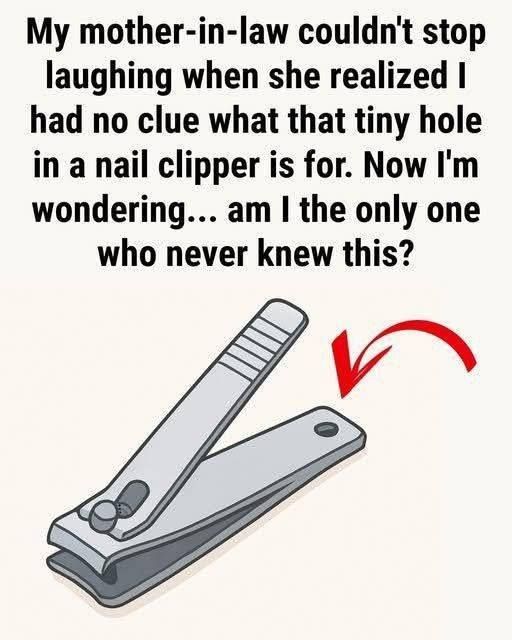
The humble nail clipper is an omnipresent fixture in medicine cabinets and travel kits across the globe. For most of us, its utility begins and ends with the routine maintenance of our fingernails or the occasional snipping of a stray thread from a sweater. We view it as a single-purpose tool, a simple lever-and-blade mechanism that performs its primary task and is then tucked away until needed again. However, if you take a closer look at the design of many traditional clippers, you will notice a persistent feature that often goes ignored: a small, perfectly round hole situated at the end of the handle. While it might appear to be a mere byproduct of the manufacturing process or a decorative flourish, this tiny aperture is a gateway to a surprising array of practical applications. In the spirit of the “tiny house” movement—where efficiency and multi-functionality are prized above all else—unlocking the secondary powers of the nail clipper can turn this grooming tool into a versatile survival and repair implement.
The most intuitive and common use for the small round hole is its function as an anchor point for a keychain. While this may seem rudimentary, the logic behind it is rooted in a fundamental law of household organization: small objects have a mysterious tendency to vanish exactly when they are most needed. By threading a sturdy metal key ring directly through the hole in the clipper, you ensure that the tool remains a permanent fixture of your daily carry. Many people rely on the thin, beaded chains that occasionally come pre-attached to the clippers, but these are notoriously prone to snapping under the slightest tension. By bypassing the flimsy chain and using the hole to secure the clipper directly to a heavy-duty ring, you create a robust attachment that guarantees you will always have a cutting tool on hand. In an era where “everyday carry” (EDC) enthusiasts obsess over high-end multi-tools, the simple nail clipper on a keychain remains one of the most cost-effective and lightweight ways to stay prepared for minor tasks throughout the day.
Beyond organization, the small hole serves a surprisingly mechanical purpose: acting as a manual wire bender. Working with thin gauge wire, such as the kind used in craft projects, gardening, or basic household repairs, can be a frustrating and often painful experience for the fingers. Attempting to create a sharp, ninety-degree bend or a tight loop using only your thumb and forefinger frequently results in uneven shapes or, worse, jagged wire ends piercing the skin. By inserting the tip of a wire through the small round hole of the clipper, you create a point of leverage. This allows you to use the handle of the clipper as a crank, applying focused force to the wire without straining your hands. The metal of the clipper provides a solid backstop, ensuring that the bend is crisp and controlled. This simple hack transforms the nail clipper into a rudimentary pair of pliers, protecting your fingertips from scratches and allowing for much greater precision in shaping metal leads or ties.
Furthermore, the nail clipper often conceals a third tool that is frequently misunderstood: the swinging metal file or “dirt picker.” While this thin iron sheet is ostensibly designed for cleaning under the nail bed or smoothing out jagged edges, its structural rigidity makes it an excellent improvised screwdriver. Many of the small electronic devices that populate our modern lives—battery compartments on remote controls, children’s toys, or the tiny hinges on eyeglasses—use miniature screws that are too small for a standard household screwdriver. In these moments of minor frustration, the tapered, flat tip of the nail clipper’s internal file can save the day. Because the file is attached to the main body of the clipper via a rivet near the small round hole, you can use the entire length of the clipper handle as a grip, providing the necessary torque to loosen or tighten a stubborn screw. It is a testament to the “hidden in plain sight” philosophy; a tool designed for hygiene becomes a lifesaver for minor mechanical repairs when a proper toolbox is out of reach.
The utility of the nail clipper extends even into the modern ritual of home shopping. We live in an age of constant deliveries, where cardboard shipping boxes arrive at our doors sealed with layers of heavy-duty packing tape. While many people reach for a kitchen knife or a pair of scissors to breach these seals, these tools can be oversized and occasionally dangerous when used in haste. The pointed end of the nail clipper’s file, or even the corner of the clipper blades themselves, provides a controlled and safe way to slice through tape. By using the clipper, you minimize the risk of cutting too deep and damaging the contents of the package, a common hazard when using larger blades. The small hole at the end allows you to maintain a firm grip with your pinky or ring finger, giving you a level of stability and control that a larger knife simply cannot offer.
Reflecting on these diverse applications, it becomes clear that the design of the nail clipper is a masterclass in unintentional or perhaps highly subtle engineering. In a world that often encourages us to buy specialized gadgets for every conceivable problem, there is a profound satisfaction in rediscovering the hidden potential of a tool we already own. The small round hole is not just a void in the metal; it is an invitation to think creatively about the objects in our environment. It encourages a mindset of resourcefulness—the idea that with a bit of ingenuity, a grooming tool can become a screwdriver, a pair of pliers can be replaced by a lever, and a keychain can become a mobile repair kit.
Whether you are trying to win an argument with a stubborn shipping box or looking to organize your keys for a more streamlined life, the nail clipper stands ready as a silent, versatile companion. The next time you hold this small piece of hardware, take a moment to look at that tiny circular opening at the end. It serves as a reminder that even the most mundane items in our lives are often more powerful than they appear. By mastering these four simple uses, you ensure that you are never truly without a tool, proving that in the realm of practical living, it is often the smallest details that carry the most weight. In the end, the smartest way to navigate the challenges of daily life is not always to find a new solution, but to look at our old tools from a completely different perspective.