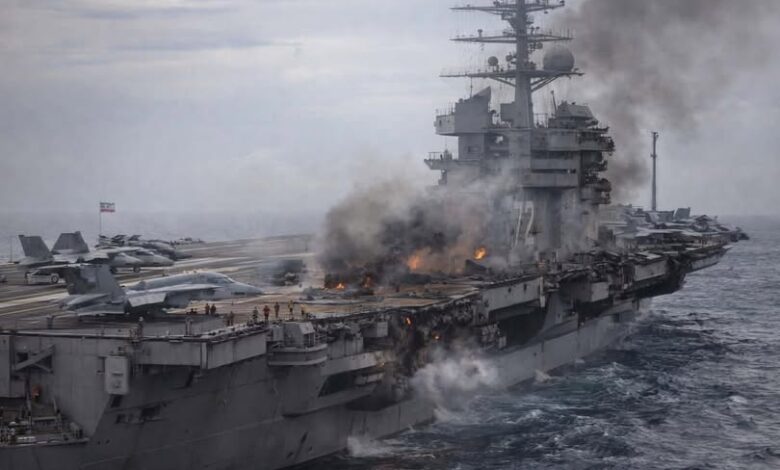
As of March 2, 2026, the waters of the Gulf and the Arabian Sea have become the epicenter of a global security crisis that threatens to reshape the geopolitical order of the 21st century. Following a series of high-stakes military maneuvers by U.S. and Israeli forces, Iranian state-linked media and officials from the Islamic Revolutionary Guard Corps (IRGC) sent shockwaves through international markets by claiming a direct hit on the USS Abraham Lincoln, a Nimitz-class nuclear-powered aircraft carrier and a primary symbol of American naval hegemony.
This claim, made late on March 1, 2025, suggests that the “naval giant” was struck by four ballistic missiles in a coordinated retaliatory strike. However, the narrative coming out of Tehran stands in stark contrast to the reports provided by the U.S. Department of Defense. This discrepancy has created a fog of war that is currently being navigated by military analysts, global leaders, and a nervous international community.
The Claim: A “New Phase” of Retaliation
According to official statements carried by IRNA and other Iranian outlets, the strike on the USS Abraham Lincoln was part of “Operation True Promise 4.” The IRGC described the action as a “direct response” to joint U.S.-Israeli operations that took place on Saturday, February 28, 2026—strikes that reportedly targeted the very heart of the Iranian leadership.
In a chilling bulletin, the IRGC announced that its campaign against “American-Zionist enemy targets” had entered a “new phase,” vowing that “land and sea will increasingly become the graveyard of terrorist aggressors.” For Tehran, the targeting of a carrier group represents the ultimate symbolic and tactical escalation. An aircraft carrier is not just a ship; it is sovereign U.S. territory, a floating airbase housing over 5,000 personnel and billions of dollars in advanced aviation technology. To claim a successful strike on such an asset is to signal that no American power projection is beyond their reach.
The Pentagon’s Rebuttal: “Missiles Didn’t Even Come Close”
The response from Washington was swift and categorical. U.S. Central Command (CENTCOM) took to social media and official briefings to label the Iranian claims as a “direct lie.” In a series of updates, defense officials clarified that while missiles were indeed launched toward U.S. naval assets in the Gulf of Oman, they were either intercepted by the carrier strike group’s sophisticated Aegis Combat System or fell harmlessly into the sea.
“The Lincoln was not hit. The missiles launched didn’t even come close,” a CENTCOM spokesperson stated. To reinforce this point, the Navy has released recent imagery and data showing the USS Abraham Lincoln continuing its mission without interruption. The carrier is currently reported to be operating in the Arabian Sea, positioned strategically behind the protection of Oman’s coastal geography, where it continues to launch F-35C stealth fighters in support of “Operation Epic Fury”—the ongoing U.S. campaign to dismantle Iranian retaliatory capabilities.
The Backdrop: Operation Epic Fury and the Death of Leadership
The tension surrounding the USS Abraham Lincoln cannot be understood without the context of the preceding 48 hours. On February 28, a massive joint air campaign by the U.S. and Israel targeted roughly 2,000 sites across Iran. Reports confirmed by multiple international news agencies indicate that these strikes were devastatingly precise, targeting command-and-control nodes, nuclear infrastructure, and the senior leadership of the Islamic Republic.
By the morning of March 1, 2026, Iranian state media took the unprecedented step of confirming that Supreme Leader Ayatollah Ali Khamenei had been killed in the initial strikes on a leadership compound in Tehran. This event has decapitated the Iranian high command and triggered a 40-day period of national mourning, while simultaneously sparking a frantic and uncoordinated series of retaliatory strikes across the region.
A Region in Flames: The Scope of the Conflict
While the USS Abraham Lincoln may have escaped harm, other areas of the region have not been as fortunate. The conflict has rapidly spread beyond the borders of Iran, involving a complex web of state actors and proxy groups:
Regional Strikes: On March 1, Iran launched a massive barrage of drones and missiles targeting U.S. bases and infrastructure in the UAE, Qatar, Kuwait, Bahrain, and Saudi Arabia.
Naval Losses: While denying the hit on the Lincoln, CENTCOM confirmed that U.S. forces successfully sank an Iranian Jamaran-class corvette at a Chah Bahar pier during the opening hours of the conflict.
The Second Front: On the morning of March 2, the war expanded into the Levant as Israel and Hezbollah began trading heavy rocket fire and airstrikes, effectively ending the ceasefire that had held since late 2024.
American Casualties: The Pentagon has confirmed that three U.S. service members were killed and five others seriously wounded during the initial phases of the operation, marking the first American combat deaths in this new theatre.
Economic and Humanitarian Fallout
The reported “attack” on the USS Abraham Lincoln, even if unverified, has sent shockwaves through the global economy. Oil prices jumped 10% in a single trading session, with analysts predicting a spike to $100 per barrel if the Strait of Hormuz remains contested. Major refineries in Saudi Arabia and oil fields in the Kurdish region have been shut down as a precaution, leading to a level of energy market volatility not seen in years.
On the humanitarian side, a nationwide internet blackout remains in effect within Iran, with connectivity dropping to just 1%. This has left millions of civilians unable to coordinate or seek safety, while regional governments struggle to manage the “travel chaos” caused by the closure of major airports in Dubai, Abu Dhabi, and Doha.
Why the Status of the Lincoln is Critical
The USS Abraham Lincoln serves as the flagship of Carrier Strike Group Three. In the current strategic calculus, the carrier is the primary platform for maintaining air superiority over the Gulf. If the Lincoln were to be significantly damaged, the U.S. would lose its most flexible tool for suppressing Iranian missile launchers and protecting the flow of global commerce through the Arabian Sea.
Furthermore, the “war of words” regarding the carrier’s safety is a battle for domestic and regional stability. For Tehran, the claim of a hit boosts morale and serves as a rallying cry for the “Axis of Resistance.” For Washington, the denial is essential to maintaining the confidence of Gulf allies who rely on the U.S. security umbrella.
Conclusion: A Fluid and Dangerous Reality
As the situation develops on this second day of March, the Gulf remains a “powder keg.” The U.S. Navy has reiterated that the USS Abraham Lincoln is “fully operational” and will continue its mission to eliminate threats from the Iranian regime. However, with Hezbollah formally entering the conflict and Iranian-backed militias in Iraq launching drones toward U.S. bases, the pressure on the Lincoln and its escort ships is likely to intensify.
The story of the USS Abraham Lincoln is no longer just a naval report; it is the lead chapter in a conflict that could rewrite the security calculations of the Middle East for generations. We will continue to monitor official channels and independent maritime tracking data to provide verified updates as this historic confrontation unfolds.