Part 1: The Birthday That Changed Everything
The afternoon was supposed to be remembered for birthday cake and children’s laughter. By noon, wet footprints covered the patio around our backyard pool, Ariel proudly wore the paper crown she refused to remove because, in her three-year-old mind, queens never took off their crowns to swim, while Glen stood beneath the maple tree battling the grill as if the smoke had personally betrayed him.
When my stepmother, Clara, arrived, she paused outside the gate before stepping inside, exactly as she always had. Fifteen years earlier, she had married my father only two years after my mother died, and ever since then she had lived carefully around our family, never sitting in my mother’s chair, never changing the curtains, and never touching anything without asking first. As a teenager, I had mistaken that caution for emotional distance, and before either of us realized it, distance had quietly become the language we both spoke.
Even so, Clara never missed Ariel’s birthday. She hugged her granddaughter, handed her a beautifully wrapped wooden tea set decorated with tiny strawberries, and smiled patiently when Ariel immediately wanted to play with it.
“Can we have tea now, Grandma?”
“After cake.”
The answer disappointed Ariel for all of three seconds before she ran back to her friends, leaving the adults to enjoy the familiar chaos of a children’s party. Preschoolers darted around the yard with water guns, my father eventually drifted asleep beneath a patio umbrella, Glen ruined his first batch of hot dogs before blaming the breeze, and Clara quietly made herself useful by refilling drinks, collecting paper plates, and retieing balloons whenever the wind pulled them loose.
At one point, I asked whether she wanted to join everyone in the pool. She glanced toward the children splashing wildly through the shallow end and smiled with the same gentle hesitation she always carried.
“Maybe later.”
“You’re wearing a swimsuit, Clara!”
“That doesn’t mean I have to be brave enough to dive in.”
I laughed, assuming she simply wanted to avoid being caught in the middle of a miniature water war.
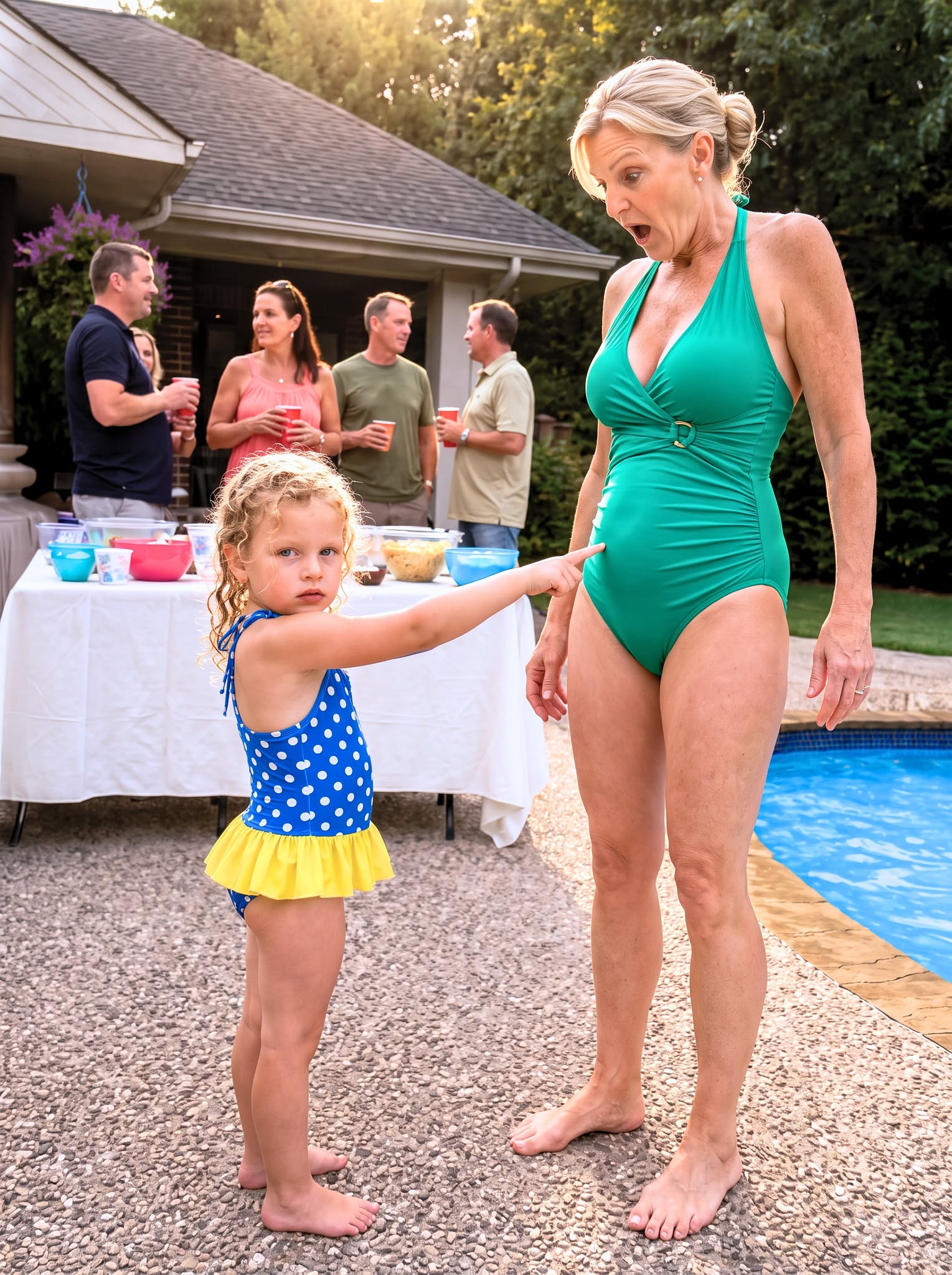
After the cake was served, the afternoon heat finally convinced Clara to change her mind. She slipped off her cover-up and carefully walked down the pool steps, holding the handrail while the children continued racing around her. Ariel happened to run past with two friends, but instead of jumping into the water, she stopped so abruptly that the other children bumped into her back.
For several seconds she simply stared at Clara.
Then she slowly lifted one finger.
Every nearby conversation stopped as the adults followed her gaze. Nobody understood what she meant until my father chuckled, Glen raised both hands from the grill, and laughter spread across the patio.
“I can confirm I am not.”
I laughed with everyone else, assuming Ariel had mixed up who she was pointing at. Embarrassed, I hurried over, crouched beside her, and gently lowered her little hand.
“Sweetheart, we don’t point at people’s bodies.”
Then I pointed toward Glen.
“Daddy is over there.”
Glen waved the barbecue tongs with an amused grin, expecting the misunderstanding to end.
Instead, Ariel looked at him, then looked back at Clara. Her expression crumpled, and frightened tears instantly filled her eyes.
“No. Daddy’s in there.”
She grabbed my wrist with surprising strength.
“No, Mommy! I’m not lying. Look.”
Confused, I followed the direction of her finger. At first I noticed nothing except the cut of Clara’s swimsuit, but as she reached for a towel and turned sideways, part of an old tattoo appeared beneath the fabric along her ribs.
It was a faded lighthouse.
Beside it was a tiny smiling sun.
My heart stopped.
I knew that crooked little sun better than almost anyone.
Glen had been drawing it for years on grocery lists, birthday cards, lunch notes, and every tiny message he ever tucked into Ariel’s backpack.
I stood so quickly that the entire backyard fell silent.
Glen walked toward us, wiping his hands on a kitchen towel.
“What happened?”
Without taking my eyes off Clara, I slowly raised my hand and pointed toward the tattoo.
“Why is your drawing on her body?”
Part 2: A Tattoo, A Lighthouse, and Fifteen Years of Silence
The question hung over the backyard like a storm cloud.
“Why is your drawing on her body?”
Glen stared at the tattoo, and the color drained from his face. The towel slipped from his hand as he looked from the faded lighthouse to Clara, while every conversation around the pool came to an abrupt halt. My aunt stopped stacking paper plates, my father slowly stood from beneath the umbrella, someone switched off the music, and suddenly the only sound left was water dripping from Clara’s swimsuit.
“Please,” Glen said quietly. “Let me explain.”
It was the worst possible thing he could have said.
Clara immediately wrapped the towel tightly around her waist, while I felt my pulse pounding louder with every passing second. Ariel stood between us, completely unaware of the chaos she had created, tracing the smiling sun in the air with her finger.
“Daddy draws the happy sun.”
Glen slowly knelt beside her.
“You’re right.”
The simple admission only deepened everyone’s suspicion.
I couldn’t take my eyes off him.
“I know you used to volunteer at an arts center downtown.”
“I did.”
“You never mentioned Clara.”
Before Glen could continue, Clara finally spoke.
“The community room on Willow Street.”
Glen looked at her in disbelief.
“Only pieces.”
She gently rested her fingertips on the lighthouse tattoo.
“I remember a young man with paint all over his hands.”
My father frowned, looking back and forth between them.
“You knew each other?”
“No.”
Clara shook her head.
“It was almost twenty years ago.”
For a long moment, nobody spoke. It was as though the entire party had disappeared around us, leaving only the four of us standing beside the pool while years of unanswered questions slowly resurfaced.
Finally, Glen drew a slow breath.
“There was a recovery program at the center. People who’d gone through surgery came in looking for artwork that could help cover their scars. I wasn’t a tattoo artist. I only volunteered to sketch ideas.”
Clara closed her eyes before continuing.
“I had just had surgery.”
Her hand remained over the tattoo.
“A tumor had been removed from my abdomen. Every time I looked at the scar, I remembered everything that could have happened instead of everything I had survived.”
My father stared at her, completely caught off guard.
“You never told me that.”
“I told you I’d had surgery.”
“You never told me why.”
“It wasn’t how I wanted people to remember me.”
The confession settled heavily over the backyard. For the first time since my father married Clara, I realized there was an entire chapter of her life none of us had ever known.
Glen looked at the lighthouse with quiet recognition.
“I drew it because lighthouses don’t stop storms. They simply keep standing through them.”
Ariel leaned against his shoulder.
“And the sun?”
He smiled faintly.
“I used to draw that little sun on everything back then.”
Clara slowly lowered the towel just enough to reveal the bottom of the tattoo. Hidden beneath the lighthouse, almost concealed by the edge of her swimsuit, were two faded words I had never noticed before.
Still Standing.
No one laughed anymore.
The suspicion that had exploded inside me only minutes earlier didn’t disappear all at once, but it began to loosen as the pieces quietly fell into place. Nearly twenty years had passed since that afternoon inside the community art center. Clara had still been using her maiden name, Glen had been a college volunteer covered in paint instead of barbecue smoke, and neither of them had any reason to remember one another after a single afternoon surrounded by strangers.
It wasn’t until Ariel recognized that tiny smiling sun that two completely separate lives unexpectedly collided again.
She walked over to Clara and gently reached toward the tattoo.
Clara nodded.
Ariel touched the lighthouse with one finger.
“Daddy made it pretty.”
A tear escaped down Clara’s cheek as she smiled.
“He did.”
For the first time in fifteen years, I didn’t see Clara as the woman who had taken my mother’s place.
I saw a frightened young woman sitting inside a crowded community room, asking strangers to help her believe she could look at herself again.
The realization softened something inside me.
But it also raised a question I had carried for most of my adult life.
“Then why have you always hated me?”
Part 3: The Lighthouse That Led Us Home
Clara looked as though the question had stolen the air from her lungs.
“I never hated you, Helen.”
Her voice cracked, but I couldn’t let the words erase fifteen years of hurt. Birthdays she left early, dinners where she barely spoke, holidays that always felt politely distant all rushed back at once. To me, every step she had taken backward had always looked like rejection.
“You barely spoke to me for fifteen years.”
“I know.”
“You missed birthdays. You left family dinners early. You always acted like being around me was something you had to endure.”
Around us, the other guests quietly guided the children back toward the pool, pretending not to notice the conversation unfolding nearby. Clara lowered herself onto a lounge chair, staring at the faded lighthouse on her side before finally admitting something I never expected to hear.
“I was afraid of you.”
For a moment, I almost laughed.
“Afraid of me?”
She nodded slowly.
“I was afraid of what loving you might look like.”
Her fingers traced the outline of the tattoo as she searched for words she should have spoken years earlier.
“Your mother had only been gone two years when I married your father. Her photographs filled every room. Her recipes were still taped inside the kitchen cabinets. You wore one of her old sweaters even during summer.”
I remembered that sweater immediately.
Green wool.
Sleeves so long they covered my hands.
“I thought if I tried to be close to you, you’d believe I was trying to replace your mother. But if I stayed too far away, you’d think I didn’t care.”
I looked at her in silence.
“So… you chose to do nothing.”
“I chose distance because I thought it was respectful.”
She lowered her eyes.
“And then so much time passed that every attempt to fix it felt harder than the one before.”
The words landed with surprising force because memories I had buried for years suddenly returned with new meaning. Clara had always wrapped my Christmas presents in plain brown paper because my mother used to do the same. She baked cinnamon rolls from my mother’s recipe without ever telling anyone who deserved the credit. Every drawing I made as a child had remained framed in the hallway, and at every graduation or family celebration, she somehow managed to stand at the edge of every photograph instead of the center.
For years, I had believed she stayed on the outside because she didn’t want to be part of my life.
Now I wondered if she had simply been waiting for permission that neither of us knew how to give.
Ariel climbed onto Clara’s lap without asking.
For an instant, Clara froze.
Then she carefully wrapped one arm around her granddaughter.
“Does the lighthouse still work?”
Clara blinked.
“No. I mean… the hope.”
For the first time all afternoon, Clara looked directly at me instead of the ground.
“Yes.”
She smiled through her tears.
“I think it does.”
The party slowly found its rhythm again, although nothing felt quite the same. Glen returned to the grill, my father quietly brought Clara a fresh towel, and Ariel spent the rest of the afternoon drawing smiling little suns on everyone’s paper cups as though she had unknowingly become the bridge holding our family together.
Near sunset, after the last guest had gone home, I found Clara sitting alone beside the now-quiet pool with her feet dangling in the water. Forgotten balloons swayed gently against the fence while the fading sunlight reflected across the surface of the pool.
I sat beside her without saying anything.
After several quiet minutes, I reached over and lightly touched the faded lighthouse.
“I thought this tattoo was hiding something that would destroy our family.”
Clara looked down at the scar that had once reminded her only of fear.
“It was hiding the reason I survived long enough to become part of it.”
Neither of us tried to hold back our tears anymore.
“I’m sorry I made you feel unwanted.”
“I’m sorry I never stopped to wonder whether you were scared too.”
Across the patio, Ariel knelt on the concrete with a box of sidewalk chalk. She proudly held up her newest masterpiece, a crooked lighthouse standing above bright pink waves. Inside the lighthouse she had drawn three smiling people holding hands beneath a tiny crooked sun.
I smiled and called out to her.
“Who’s that?”
She looked up as though the answer were the most obvious thing in the world.
“Family.”
Clara quietly slipped her hand into mine.
I held it.
For years, we had stood on opposite sides of the same grief, each convinced the other didn’t want us to cross the distance between us. It took a three-year-old little girl, a faded lighthouse, and a tiny smiling sun to show us that the doorway had been there all along.