PART 1: THE DINNER THAT EXPOSED EVERYTHING
My name is Henry Carter. At seventy-two, I had already spent most of my adult life building a construction company in Richmond, starting with only two employees and gradually turning it into a successful commercial firm before selling the business in 2019.
Very few people knew what the company had actually been worth when I sold it, including my son, David. I deliberately kept my lifestyle simple because wealth had taught me that once people knew how much money you possessed, it became much harder to know whether they valued you or what they hoped to receive from you.
My late wife, Margaret, understood that better than anyone. Years earlier, she had once asked me whether the people closest to us would still remember how to love me if they could no longer see the money.
At the time, I assured her they would.
Seven years after Margaret died, I finally understood why she had been worried.
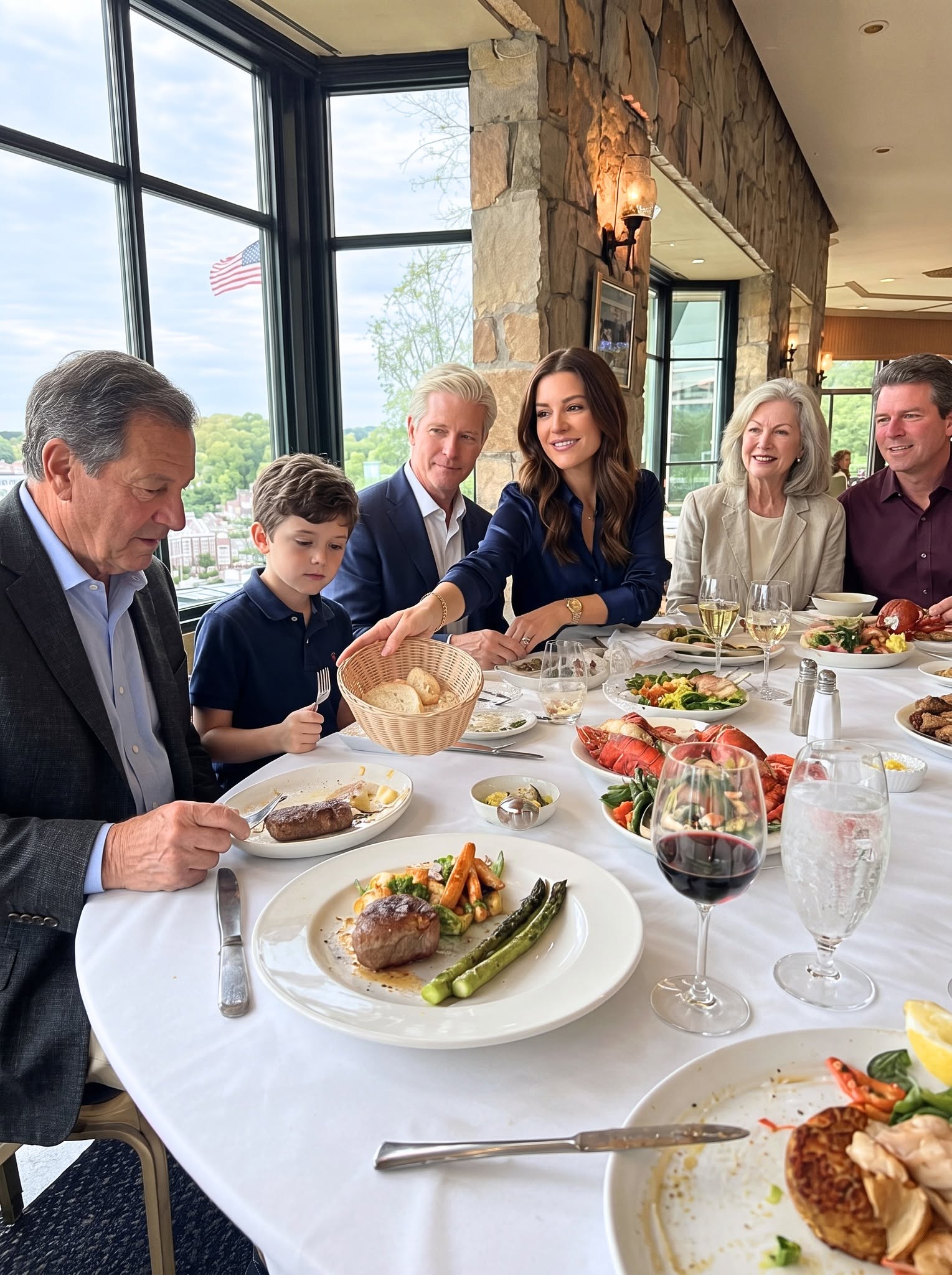
David invited me to celebrate his birthday at Harrington’s Steakhouse, an expensive restaurant where even an ordinary dinner could easily become a substantial bill. His wife, Emily, sat beside him, while her parents and my nine-year-old grandson, Michael, completed the table.
Everyone began ordering expensive dishes without much concern for the price. I wasn’t interested in anything extravagant, so when the server reached me, I simply ordered the salmon.
When the food arrived, plates were placed in front of everyone except me. I initially assumed the kitchen was running behind on my order, but then Emily reached for the bread basket and pushed it across the table in my direction.
“Bread will be easier for you, Henry,” she said. “You’re seventy-two. Food like this is wasted on someone your age.”
Conversation around the table immediately stopped. I looked toward David, expecting my son to challenge what his wife had just said or at least ask the server what had happened to my meal.
Instead, he continued cutting into his steak as though nothing unusual had occurred.
“Dad, don’t make this awkward,” he said. “She’s right.”
Of everyone sitting around that table, only Michael objected. My grandson looked at his own plate and immediately offered to share it with me.
“Grandpa, you can have some of mine.”
I rested my hand gently on his shoulder and assured him that I was fine. Then I took a single roll from the basket, drank some water, and gave the adults at the table the only response they were going to receive from me that evening.
“Noted.”
Nearly forty years in business had taught me that anger could sometimes hide information that silence would expose. So I didn’t argue with Emily, confront David, or give either of them the satisfaction of watching me become upset.
After dinner, I returned to my truck but didn’t immediately drive away. Through the restaurant window, I could still see everyone sitting around the table, laughing and enjoying the evening as though nothing had happened.
Michael wasn’t laughing.
He kept glancing toward the chair I had left empty, and seeing the concern on my grandson’s face hurt considerably more than being denied a meal.
The following morning, I walked into my kitchen and noticed a bank envelope sitting beneath the fruit bowl. I assumed it was an ordinary statement until I opened it with Margaret’s old silver letter opener and began examining the pages inside.
The first few accounts were familiar.
Then I reached the third page.
An account carrying my name showed a remaining balance of $47,218. The statement also showed that previous correspondence for the account had been mailed to David’s home address.
I stared at the page for several moments, trying to remember whether I had somehow forgotten opening it.
I hadn’t.
There was no legitimate reason for an account in my name to exist at my son’s address, and I had never authorized David to manage one for me.
Suddenly, the previous night’s expensive birthday dinner felt different. David had sat at that table presenting himself as a successful man generously paying for everyone around him while allowing his seventy-two-year-old father to eat from a bread basket.
Now I was staring at a bank account carrying my identity that I had never created.
I picked up my phone and called the one person I trusted to tell me exactly what I was looking at.
His name was Robert Hayes.
He was a retired forensic accountant.
And before that morning was over, I would discover that the missing salmon was the least important thing David had taken from me.
PART 2: THE MONEY BEHIND DAVID’S GENEROSITY
The first person I called was Robert Hayes, an old friend who had spent most of his career working as a forensic accountant. I showed him the statement, and it took him only a few minutes to realize that the unfamiliar account was far more serious than a simple banking error.
Someone had opened the account using my identity and arranged for every statement to be delivered to David’s home. The only reason I had received this particular envelope was because a bank employee had apparently corrected the mailing address, accidentally revealing an account I was never supposed to know existed.
My next call was to my attorney, Patricia Vance. She reviewed several documents I had signed years earlier when David’s business was struggling and I stepped in to help him secure financing.
Among those papers was a limited power of attorney. Its purpose had been narrow, allowing David to handle specific matters connected to the loan, but Patricia quickly suspected he had used that authority for something entirely different.
The secret account appeared to have been opened using my information and that old authorization.
Patricia warned me not to confront David yet. Before he knew we had discovered the account, she wanted Robert to determine exactly how much money had passed through it and where every dollar had gone.
For the next three weeks, Robert followed the transactions one by one. When he finally placed his report in front of me, the numbers explained far more than I had expected.
Approximately $112,000 had entered the account.
Most of the money came from rental income generated by two commercial properties I owned. Someone had submitted fraudulent instructions to the property manager directing those payments away from my regular account and into the secret one.
There were smaller transfers as well. Money had periodically been taken from my checking account in amounts deliberately kept below the threshold that would normally trigger one of my automatic notifications.
About $65,000 was already gone.
Robert traced the spending to renovations at David and Emily’s house, expenses connected to Emily’s parents, and several vacations. Looking through those transactions, I suddenly found myself thinking again about the birthday dinner.
David had sat at Harrington’s paying for expensive meals and presenting himself as the generous host. Yet part of the lifestyle supporting that image had quietly been financed with money taken from me.
For years, David had enjoyed telling people that he had built his life without anyone’s help. I never corrected him because I believed allowing my son to feel proud of his accomplishments was more important than receiving recognition for everything I had done behind the scenes.
I had helped when his business struggled, covered expenses when money was tight, and stepped in whenever he needed support. None of those things had ever come with conditions because I considered them gifts from a father to his son.
But sitting across from Robert’s report, I began to understand the danger of remaining silent for too long. Silence can preserve someone’s dignity, but it can also allow gratitude to slowly turn into entitlement.
By hiding every sacrifice I had made, I had allowed David to rewrite our history. Somewhere along the way, he had stopped seeing my help as something freely given and started treating my money as something he was automatically entitled to use.
Patricia eventually asked me what I wanted to happen next.
The answer wasn’t revenge.
David was still my son. I had raised him, loved him, watched him become a father, and no amount of anger could erase those years.
But loving him didn’t require pretending that he hadn’t betrayed me.
I wanted the truth.
I wanted the money repaid.
And I wanted the deception to stop permanently.
Patricia sent David a formal but straightforward letter requesting that he meet with us privately at her office. He called me before the scheduled appointment, his voice noticeably different from the confident son who had told me not to make dinner awkward.
“Dad, I can explain.”
“We’ll talk at Patricia’s office,” I replied.
David arrived alone.
Patricia placed the bank statements, property records, transfer instructions, and Robert’s accounting report across the conference table. David studied them without saying much, but he never denied that he had opened the account or redirected the money.
I didn’t ask him how he had done it.
By then, I already knew.
There was only one question I needed him to answer.
“Did you believe I would never discover this, or did you believe it would not matter?”
David stared down at the desk for several seconds before finally responding.
“I thought the estate would eventually sort everything out,” he admitted.
His answer told me exactly what he meant, but I needed to hear him say it plainly.
“You thought I would be gone before it became a problem.”
David didn’t look at me.
“Yes.”
For a long moment, I said nothing.
The previous week, I had believed the cruelest thing my son could do was sit beside me in a restaurant while his wife decided I was too old to deserve a proper meal.
I had been wrong.
David had been spending money that belonged to me while quietly assuming that, eventually, I wouldn’t be alive to ask for it back.

PART 3: THE ACCOUNTABILITY I CHOSE
David’s answer changed something between us that I knew could never simply return to normal. He hadn’t merely taken my money; he had justified it by assuming that I would eventually die and the inheritance would make his actions irrelevant.
There was still one part of the situation I needed to understand. I thought again about the birthday dinner and the way Emily had pushed the bread basket toward me while David sat silently beside her.
“Did you agree with Emily, or were you afraid to challenge her?”
David admitted that Emily knew they were experiencing financial trouble, but she had no idea where the additional money supporting their lifestyle had actually come from. Instead of telling his wife the truth, David had allowed her to believe that I had plenty of money but selfishly refused to help them.
I looked at him across Patricia’s conference table.
“So she resented me for being stingy,” I said, “while you quietly used my money to support your family.”
David couldn’t answer.
That explained more about the restaurant than I wanted to know. Emily’s behavior had still been cruel, but David had spent years feeding the resentment behind it while secretly taking the very money she believed I refused to share.
I told David that he would have to explain everything to his wife himself. Whatever happened inside their marriage afterward belonged to them, and I wasn’t going to protect him from the consequences of another lie.
Patricia then placed the proposed settlement in front of him. The remaining $47,218 in the unauthorized account would be returned to me immediately, and every dollar of redirected rental income would be repaid according to a structured schedule.
The bank would close the account and formally document David’s misuse of the limited power of attorney. If he complied with every condition, I was willing to resolve the matter civilly instead of pursuing criminal charges.
David looked at the agreement, then finally raised his eyes toward me.
“Why are you giving me this chance?” he asked.
“Because you are my son,” I answered. “And because Michael needs his father present. But this chance will not come twice.”
I made the final condition unmistakably clear. If David ever accessed another account, property, or asset belonging to me without permission, Patricia already had everything necessary to move forward.
Three weeks later, I met Michael at a park. The moment he saw me, he ran across the grass and wrapped his arms around me.
I hugged him back and reassured him that everything was going to be all right.
“I’m better,” I assured him.
We walked together around the pond for a while before Michael suddenly stopped. His expression became unusually serious for a nine-year-old.
“Grandpa, what they did at the restaurant was bad.”
There was no reason to pretend otherwise.
“Yes,” I said. “It was.”
“I didn’t like it.”
“I know. I saw.”
Michael thought about that for a moment before nodding.
“When I grow up, I’m going to be different.”
I looked at my grandson and believed him.
Margaret’s question returned to me then, the one she had asked years earlier about whether the people in my life would remember how to love me when my money wasn’t visible. I had once believed the answer would be simple, but now I understood that it wasn’t.
My son had failed that test badly.
My grandson hadn’t.
David and I weren’t suddenly repaired because he had agreed to repay what he took. We were only beginning to discover whether a relationship damaged by that level of betrayal could eventually be rebuilt.
Accountability had to come first.
Trust could follow later, if he earned it.
As Michael and I started walking back toward the car, he reached for my hand. He held it all the way across the park, and that small gesture meant more to me than every expensive dinner David could ever have purchased.
The hidden bank account had finally forced me to understand something I should have recognized years earlier. Generosity isn’t buying an impressive dinner with money that secretly belongs to someone else, and love isn’t remaining silent simply to protect someone from the consequences of their choices.
Family isn’t proven by inheritance, expensive gifts, or the size of an account.
Sometimes it is revealed in something much smaller.
A nine-year-old boy notices that his grandfather has no plate while everyone else is eating. He offers part of his own meal without being asked, remembers how that moment made him feel, and makes himself a promise.
“When I grow up, I’m going to be different.”
And this time, I believed the next generation might actually mean it.