PART 1: LOCKED OUT OF HER OWN HOME
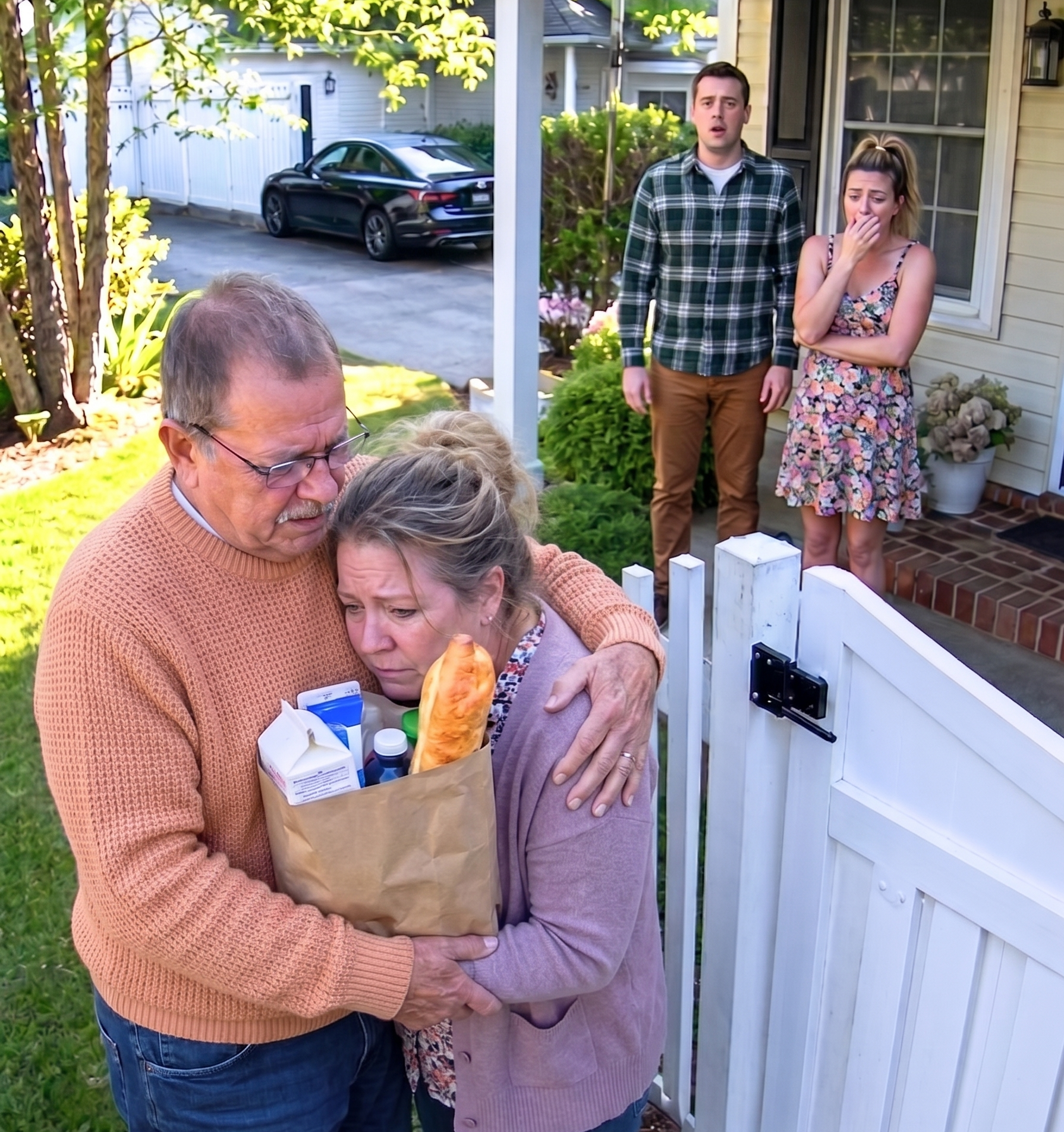
When I returned from work that evening, I found my wife standing outside our front gate with a small grocery bag hanging from one hand. At first, I assumed Linda was waiting for me because she often spent evenings near the garden when the roses were blooming, but this time she wasn’t looking at the flowers.
She was staring at the locked gate as though someone had suddenly decided she no longer belonged on the other side of it. I parked my truck, hurried toward her, and immediately knew something was wrong.
“Linda? What are you doing out here?”
She turned toward me, and the expression on her face stopped me cold. After thirty-eight years of marriage, I knew every version of Linda’s sadness, anger, and disappointment, but what I saw that evening was humiliation.
She held a small paper bag containing bread, milk, and a bottle of her heart medication. Her purse remained over one shoulder while she tightly clutched the house keys that should have allowed her into the home where she had lived for decades.
“Tom,” she whispered, “Ethan changed the code.”
My chest tightened.
“What?”
Linda struggled to get the next words out.
“He said this house belongs to him now. He said I should leave before you got home because I’ve been ‘living off his future’ long enough.”
For several seconds, I couldn’t even process what she had told me. Ethan was our only son, thirty-two years old and married to Ashley, a woman who rarely lifted a finger around our home but frequently discussed what “we” should renovate once Linda and I were gone.
I walked over to the keypad and entered the access code we had used countless times.
Denied.
I tried it again, thinking perhaps I had entered one of the numbers incorrectly.
Denied.
Linda’s eyes began filling with tears.
“He told me not to make a scene.”
I gently took the grocery bag from her hand and then held out mine.
“Come with me.”
She hesitated, clearly worried about what would happen once we went inside.
“Tom, don’t fight him.”
“I’m not going to fight him,” I said. “I’m going to remind him.”
We walked around the house toward the side entrance beside the garage. Ethan had forgotten something important: I had built that house years before smart locks, electronic keypads, and security apps existed, and I had never trusted technology enough to eliminate every old-fashioned backup.
Inside the shed, I retrieved the spare key I kept hidden in my work boot. The manual lock on the side entrance opened exactly as it always had.
When Linda and I stepped inside, we found Ethan and Ashley standing in our kitchen. They were measuring one of the walls and discussing changes as casually as though ownership had already transferred to them.
Ethan froze when he saw us.
“Dad,” he said. “We need to talk.”
I placed Linda’s grocery bag carefully on the kitchen counter. Then I turned toward the son who had apparently decided his parents’ home was already part of his inheritance.
“No,” I said. “Tonight, you listen.”
Ashley crossed her arms before Ethan could respond. Her expression suggested that Linda and I were creating an unnecessary problem rather than confronting them over something they had done.
“Tom, this is getting uncomfortable,” she said. “We were only trying to make practical decisions.”
I stared at her.
“Locking my wife out of her own home is practical?”
Ethan immediately stepped in to defend what they had done.
“Mom was being emotional. She wouldn’t listen.”
Linda remained behind me without saying anything. Seeing her standing silently in the kitchen she had decorated, cleaned, and filled with family dinners for nearly forty years made Ethan’s words even harder to hear.
I looked directly at him.
“What exactly did she not listen to?”
Ethan sighed with the exhausted expression of someone who somehow believed he was the responsible adult in the room.
“Dad, be realistic. You’re getting older. This house is too much for you. Ashley and I talked it over. We should move in now, take over the property, and you and Mom can stay in the guest room until we figure out senior living options.”
A quiet sound escaped Linda behind me. My anger didn’t explode; instead, something inside me became frighteningly calm as I realized my son and his wife had already begun planning the end of our independence without ever bothering to include us in the conversation.
“You talked it over,” I repeated. “Without us.”
Ashley raised her chin.
“Someone has to think ahead.”
I turned back toward Ethan.
“And you told your mother to leave?”
He avoided my eyes.
“I told her to cool off.”
I pointed toward the grocery bag sitting on the counter.
“She was outside the gate with her medication in a grocery bag.”
Ethan said nothing.
That silence gave me the answer I needed.
I walked toward my study, and Ethan followed immediately. His confidence began fading because he knew that room contained every important document I had accumulated during decades of marriage, business, and property ownership.
“Dad,” he said, “don’t overreact.”
I opened the safe.
Inside were the deed to the house, our wills, trust documents, insurance records, and the files connected to the hardware company I had spent years building. Until that evening, I had always assumed Ethan would eventually inherit much of what those documents represented.
Someday.
But someday had just changed.
I placed the folder on the desk and looked directly at him.
“This house does not belong to you,” I said. “It belongs to your mother and me. The company does not belong to you either. Neither do our savings, our retirement, or the future you and Ashley apparently already spent.”
Ashley appeared in the doorway, but the confidence she had shown in the kitchen was gone. Her face had become noticeably pale as she stared at the documents spread across my desk.
I picked up my phone and called my attorney, Mark Ellison. When he answered, I switched the call to speaker so there could be no misunderstanding about what I intended to do.
“Mark,” I said, “I need to revise the trust, remove Ethan as successor trustee, remove him from the company transition plan, and draft a formal notice barring him and Ashley from entering the property without written permission.”
Ethan stared at me in disbelief.
“Dad, you can’t be serious.”
I looked past him toward Linda. Her hands were still trembling after being locked outside the home where she had spent almost four decades building our life.
“I’ve never been more serious in my life.”
PART 2: THE FUTURE THEY THOUGHT THEY HAD INHERITED
Ethan’s shock quickly turned into anger. Until that moment, he had apparently believed everything Linda and I had spent decades building was simply waiting for him to claim whenever he decided the time had come.
“You’re choosing Mom’s drama over your own son?”
Linda flinched behind me.
That small reaction caught my attention immediately. I suddenly wondered how many cruel remarks Ethan had already made to his mother when I wasn’t around to hear them, and whether being locked outside had merely been the first time his behavior became impossible for me to ignore.
I stepped between them and looked directly at my son.
“Lower your voice in my house.”
Ashley grabbed Ethan’s arm and immediately tried to make their actions sound reasonable.
“This is ridiculous. We were trying to help.”
I shook my head.
“No. You were trying to inherit early.”
Ashley’s expression hardened, but she couldn’t produce an answer. There was nothing helpful about changing our gate code, forcing Linda outside, and discussing senior living arrangements while measuring our kitchen for renovations.
Mark was still listening through the speakerphone. Unlike everyone else in the room, his voice remained completely calm.
“Tom, I’ll prepare everything first thing in the morning. For tonight, if they refuse to leave, call the police.”
Ethan stared at my phone as though even hearing those words was a betrayal.
“The police? On your own son?”
For a moment, I couldn’t answer. I remembered every baseball game I had attended, every school project Linda and I had helped him finish, every childhood illness that kept us awake, and every sacrifice we had made so our only son could grow up with security we ourselves had never enjoyed.
Then I looked at Linda.
“You stopped acting like my son when you locked your mother outside.”
Something shifted in Ethan’s expression, and for an instant I thought the reality of what he had done might finally reach him. But whatever regret appeared was quickly buried beneath his pride.
Twenty minutes later, Ethan and Ashley left. Ethan slammed the front door behind him hard enough to shake the picture frames hanging along the hallway.
When the house became quiet again, Linda sat at the kitchen table and began crying. I made her a cup of tea, placed her heart medication beside it, and sat across from the woman I had promised to protect nearly four decades earlier.
I apologized.
She shook her head.
“You didn’t do it.”
“No,” I said. “But I didn’t see it soon enough.”
The weeks that followed were difficult. Ethan bombarded us with calls and messages accusing Linda and me of destroying the future he had apparently spent years assuming was guaranteed to him.
Ashley took her complaints online. Without mentioning us directly, she posted vague messages about “greedy older generations” refusing to step aside and allow younger family members to build their futures.
I didn’t respond to either of them.
Instead, I let Mark handle what actually mattered.
The attorney’s notices were delivered, the company board was informed that Ethan had been removed from the transition plan, and our estate documents were formally revised. We also changed every lock and access code so neither Ethan nor Ashley could enter the property again without our permission.
Removing Ethan as successor trustee was harder emotionally than I expected. For years, Linda and I had structured our plans around the assumption that our only son would eventually become responsible for protecting everything we had built.
But the afternoon he locked his own mother outside changed the meaning of that responsibility. I could no longer give control of Linda’s security to someone who had already demonstrated that he viewed her home as his future property.
The company decision hurt too.
I had built my hardware business from almost nothing and had always imagined Ethan eventually taking over. When he was younger, he spent summers sweeping floors, stocking shelves, and following me around the warehouse asking questions about everything I did.
Somewhere along the way, however, learning the business had become expecting the business.
Those were not the same thing.
Then our daughter Megan learned what had happened.
She called from Denver after hearing a distorted version from Ethan, who apparently claimed Linda had become unreasonable about “family planning.” Once I told Megan that her brother had changed the gate code and left their mother outside with her medication, she became completely silent.
Two days later, she was standing in our kitchen.
The moment Megan saw Linda, she wrapped both arms around her mother and held her for a long time. She didn’t ask about the trust, the company, or what Ethan might lose.
“You’re coming to stay with me for a week. Dad too.”
Linda initially protested that we didn’t need to leave our own home. Megan simply reminded her that she wasn’t asking us to run away; she was inviting her parents to take a break somewhere they would be cared for instead of treated like obstacles.
So we went.
That week in Denver became the first genuinely peaceful vacation Linda and I had taken in years. Without the company, estate documents, Ethan’s messages, or the house surrounding us, we finally had enough distance to understand how deeply his sense of entitlement had entered our family.
Linda eventually told me there had been warning signs long before the day at the gate. Ethan had made comments about which furniture Ashley wanted, questioned why we still needed such a large house, and repeatedly suggested that transferring assets early would make things “simpler.”
Linda hadn’t told me because she didn’t want to create tension between father and son.
That realization hurt.
For years, both of us had been protecting family peace by refusing to acknowledge the same problem. Ethan had mistaken that silence for permission.
When we returned home, the roses were still blooming beside the gate. Linda stood there for a moment before entering the new code, and I watched the gate open for her without hesitation.
That simple moment meant more to me than it should have.
The house had never stopped belonging to us.
But now Ethan finally understood that neither had our future.
For almost three months, we heard nothing meaningful from him. The angry calls eventually stopped, Ashley’s online complaints disappeared, and the silence between us settled into something I couldn’t tell was permanent or temporary.
Then, one evening, the doorbell rang.
When I opened the door, Ethan was standing alone on the porch.
Ashley wasn’t with him.
There were no documents in his hands, no demands about the company, and no argument prepared about the trust.
Instead, his eyes were red.
And in one hand, he carried a small grocery bag.
Inside were bread, milk, and Linda’s favorite tea.
For several seconds, none of us spoke.
Then Ethan looked past me toward his mother.
“I’m sorry,” he said. “I thought the house was my future. I forgot it was your life.”
Linda began to cry.
But this time, she didn’t step aside and invite him in.
She opened the door only halfway.

PART 3: FORGIVENESS DOESN’T MEAN GIVING THE KEYS BACK
Linda stood behind the half-open door, studying the son who had once forced her outside her own gate. Three months earlier, Ethan had treated our home like an inheritance he was entitled to claim early; now he stood on the porch carrying an ordinary grocery bag and looking more uncertain than I had ever seen him.
“I’m sorry,” he said. “I thought the house was my future. I forgot it was your life.”
Linda cried, but she didn’t immediately invite him inside. She had spent most of her life putting our children’s feelings before her own, and I could see how difficult it was for her not to fall back into that habit.
Eventually, she opened the door a little wider.
But not completely.
That distinction mattered.
Forgiveness, I learned, is not the same as handing someone the keys again.
Ethan placed the grocery bag on the porch table. Inside were bread, milk, and Linda’s favorite tea, an unmistakable reminder of the small bag she had been holding the evening he locked her outside.
For the first time, he seemed to understand why that image had affected me so deeply. His mother hadn’t been standing outside with suitcases after voluntarily leaving home; she had been carrying groceries and medication back to a house where her own son had decided she no longer belonged.
Ethan lowered his eyes.
“I don’t expect you to forgive me today.”
Linda wiped her cheeks.
“Good. Because I can’t.”
He nodded slowly.
“I understand.”
“No,” Linda said. “I don’t think you do yet.”
Ethan looked up at her.
“You didn’t just change a code. You made me feel like I was already dead and you were waiting for my things.”
Ethan’s face crumpled.
“Mom…”
She shook her head.
“You need to hear it.”
For once, Ethan didn’t defend himself. He didn’t blame Ashley, call his mother emotional, or explain that he had only been thinking about the future.
He simply listened.
Eventually, Linda allowed him into the living room, but the conversation lasted less than an hour. Before Ethan left, I made one thing completely clear.
“The trust isn’t changing back.”
He looked at me.
“Dad, I’m not here about the trust.”
“I hope not.”
“I’m not.”
I wanted to believe him, but trust wasn’t something Ethan could restore with one apology and a bag of groceries. He had spent years gradually turning expectation into entitlement, and repairing that damage would require something much harder than saying he was sorry.
We began family counseling several weeks later. Ethan attended alone because Ashley refused to participate, insisting that Linda and I were using money to control our children.
The counselor quickly forced us to confront truths none of us particularly enjoyed. Linda had hidden Ethan’s increasingly disrespectful behavior because she wanted to protect my relationship with him, while I had spent years assuming that providing financial security automatically meant our children understood gratitude.
Ethan had his own truth to face.
He admitted that he had spent so long hearing that the company would someday be his and that the house would eventually pass to him that he stopped thinking of either as belonging to Linda and me. In his mind, inheritance had quietly transformed from something he might receive one day into something we were temporarily preventing him from using.
“I thought I was protecting what would eventually be mine.”
I stared at him.
“That was the problem.”
He nodded.
“I know.”
“No, Ethan. Your mother and I weren’t occupying your future. We were living our lives.”
He looked toward Linda.
“I understand that now.”
Understanding it once wasn’t enough.
Every visit had to be earned. Every apology had to be followed by different behavior, and neither Linda nor I allowed guilt to rush us into restoring privileges simply because Ethan was our son.
The trust remained exactly as Mark had rewritten it.
Ethan was not restored as successor trustee.
He was not returned to the company transition plan.
And he did not receive a new gate code.
Months passed.
To his credit, Ethan continued showing up.
Sometimes he came for dinner. Sometimes he helped me with work around the garden, and occasionally he brought groceries for Linda without turning the gesture into an apology or expecting praise afterward.
Ashley eventually stopped coming altogether. Their marriage had begun deteriorating shortly after Ethan lost his expected position in the company, and I couldn’t ignore what that timing suggested.
But I refused to celebrate their problems.
Ethan needed to understand his own choices without replacing one person to blame with another. Ashley may have encouraged his entitlement, but she hadn’t forced him to change the gate code or tell his mother she was living off his future.
Those decisions belonged to him.
Nearly a year after everything happened, Ethan and Ashley separated. By then, his relationship with Linda had improved enough that she could spend time with him without becoming tense, although she still kept boundaries that would once have made her feel guilty.
One evening, Ethan asked whether I would ever reconsider the company succession plan.
I looked at him for a long moment.
“Are you asking as my son or as someone who wants the company?”
He smiled faintly.
“My therapist would probably tell me that question is exactly why I shouldn’t ask yet.”
For the first time, I laughed.
“Your therapist sounds expensive.”
“She is.”
“Keep paying her.”
Ethan laughed too.
It wasn’t reconciliation in some perfect storybook sense. What we were rebuilding was smaller, slower, and more cautious than the relationship we had before.
But perhaps it was more honest.
Linda and I also changed.
We stopped talking about our property as though everything we owned already belonged to our children. We updated our estate plan around what would protect each other first, while anything eventually left to Megan or Ethan would be a gift rather than a promise they were entitled to organize their lives around.
Megan supported the decision immediately.
Ethan eventually did too.
One evening, Linda and I sat together on the front porch while the sun disappeared behind the roses. She rested her head against my shoulder, and for a while neither of us said anything.
Then she squeezed my hand.
“Thank you for bringing me back inside,” she whispered.
I turned toward her.
“This was always your home.”
She smiled.
The gate stood several yards away, the same gate where I had found her holding that grocery bag and trying not to cry. The code had been changed since then, and only Linda and I knew it.
Ethan didn’t need it.
If he wanted to visit, he knocked.
And strangely enough, I came to appreciate the sound of that knock because it meant he finally understood something he had once forgotten.
A door opened by someone who wants you inside means far more than a key you believe you’re entitled to possess.
I don’t know whether Ethan will ever become successor trustee again or whether he will eventually have a role in the company. Those decisions belong to a future Linda and I are still alive to make for ourselves.
What matters is that our son is slowly becoming part of our lives again without assuming that being our child gives him ownership over them.
That night taught me something I wish I had understood much earlier.
Parents spend decades building things for their children: homes, businesses, savings, opportunities, and memories. Somewhere along the way, however, children can begin confusing what their parents hope to leave them someday with something they already own.
Ethan made that mistake.
He looked at our house and saw his inheritance.
I looked at Linda standing outside its gate and saw thirty-eight years of marriage being treated like an obstacle to someone else’s future.
So yes, I forgave my son.
But I never gave him the keys back.
Because forgiveness can reopen a relationship.
It does not have to surrender the lock.