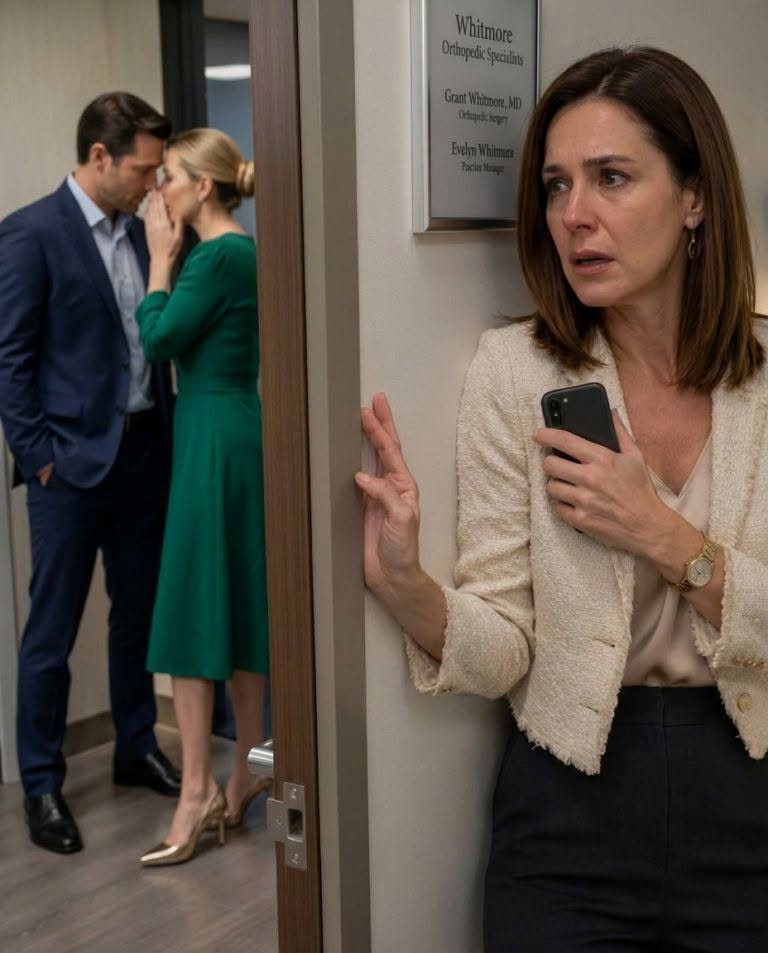
I woke up in the company medical room after collapsing, only to hear the secretary whisper, “Are you sure she took it?” Then my husband laughed and said, “Relax. By tomorrow morning, everything will be ours.” That was when I grabbed my phone and texted my attorney: “Execute the plan. Now.”
I came to with the sharp scent of antiseptic in my nose and the low buzz of the refrigerator in the company medical room.
For a few seconds, I had no idea where I was. Then the ceiling tiles came into focus, a bitter metallic taste coated my mouth, and pieces of memory returned: the champagne toast in Conference Room A, my husband’s palm against my lower back, the secretary smiling too hard as she passed me a glass.
Then blackness.
I kept my eyes barely open when I heard voices outside the half-open door.
“Are you sure she took it?” Vanessa Hale whispered.
My husband, Grant Whitmore, gave a soft laugh. “Relax. By tomorrow morning, everything will be ours.”
Everything.
My company. My patents. My mother’s trust. The voting shares I had refused to hand over. The new merger deal valued at eighty million dollars.
My pulse hammered so violently I feared the monitor would expose me, but it was not attached. They had not called an ambulance. They had not called a physician. They had brought me here because they wanted me alive, weakened, and simple to relocate.
Vanessa spoke again. “What if she wakes up?”
“She won’t be clear enough to understand anything. The paperwork is ready. She’ll sign the emergency authorization, the board will accept it, and by the time her attorney hears anything, it’ll be finished.”
I stared at my phone on the chair beside the bed.
Grant had made one mistake.
He still thought I trusted him.
Three months earlier, after my CFO uncovered irregular transfers disguised as consulting fees, I hired a private investigator. Two weeks later, I discovered Grant had been meeting Vanessa at an Arlington hotel. A week after that, my attorney, Ruth Caldwell, created a contingency plan.
If I became medically incapacitated under suspicious circumstances, Grant would lose all temporary authority. If any emergency document surfaced with my signature, an injunction would be triggered. If my phone sent one precise sentence, Ruth would act at once.
My fingers shook as I reached toward the chair.
Outside the door, Grant said, “I’ll bring her home tonight. In the morning, she’ll be too sick to question why the board already voted.”
Vanessa giggled under her breath. “And after that?”
“After that, my love, Evelyn becomes a footnote.”
I unlocked my phone with my face, praying the dim light would be enough. It opened. I found Ruth’s name.
My thumb trembled once. Then steadied.
Execute the plan. Now.
The message delivered.
Vanessa’s heels clicked away. Grant pushed the door wider and entered, wearing the worried-husband expression he had perfected over years.
“Evelyn,” he said softly. “You scared me.”
I looked at him and smiled.
“Did I?”
Part 2
Grant stopped in the doorway.
For one split second, his smile slipped. He had expected confusion, fear, maybe the slow obedience of a woman too drugged to fight back. Instead, he found me conscious, still, and watching him like I was counting down seconds.
He recovered fast. Pretending had always been one of his talents.
“You fainted,” he said, moving closer. “Too much stress. Too little sleep. I told everyone you needed rest.”
“Everyone?” I asked.
“The board members. The investors. Your staff.” He sat at the edge of the bed and reached for my hand.
I pulled away.
His jaw flexed.
“You should be grateful,” he murmured. “I handled everything.”
“I’m sure you did.”
He examined my face. “Did you hear anything?”
I let my eyelids lower a little. “Like what?”
His expression softened again, though his eyes did not. “Nothing. You’re exhausted.”
He turned to the small counter, where a plastic cup of water sat beside a folded packet of documents. I saw the company seal on the first page.
“Drink,” he said. “Then we’ll go home.”
“No.”
The word hit harder than I expected.
Grant looked back slowly. “Excuse me?”
“I said no.”
For a moment, the quiet room seemed too small for both of us. He dropped his voice. “Evelyn, don’t make this ugly. You’re unwell. You collapsed in front of half the executive team.”
“I collapsed after drinking champagne Vanessa handed me.”
His face stayed still, but his fingers tightened around the cup. “That’s a serious accusation.”
“It is.”
“You have no proof.”
The phone on the chair buzzed once.
Grant glanced toward it.
I moved quicker than he expected, grabbing it and pressing it to my chest. Ruth Caldwell’s message filled the screen.
Stay where you are. Security and federal counsel are on-site. Do not sign anything.
Grant saw enough.
His mask dropped.
“You stupid woman,” he breathed.
There he was. Not the charming husband at charity events. Not the supportive spouse in business profiles. Just a cornered man in expensive shoes with panic in his eyes.
“You were never as smart as you thought,” I said.
He seized my wrist. Hard.
Pain flashed up my arm, but I did not scream. The door was still open. The hallway camera had a clear view into the room. I had installed those cameras after a former employee threatened me during a layoff. Grant had argued against them.
He had forgotten they existed.
“You don’t understand what you’re doing,” he hissed. “That company survived because of me.”
“That company existed before I met you.”
“I gave you access. I gave you confidence. I made people take you seriously.”
I almost laughed. “You spent my money, wore my name, and slept with my secretary. Don’t confuse proximity with contribution.”
His grip tightened.
Then a man spoke from the doorway.
“Mr. Whitmore, remove your hand from your wife.”
Grant froze.
Two uniformed security officers stood behind Daniel Pierce, my chief legal officer. Behind him was Ruth Caldwell, silver-haired, composed, and carrying the kind of calm that usually arrived just before someone was destroyed in court.
Farther down the hall, Vanessa stood between two guards, her face drained white.
Grant let go.
Ruth stepped in first. “Evelyn, are you able to speak clearly?”
“Yes.”
“Do you consent to immediate medical testing by an independent physician?”
“Yes.”
“Did you authorize any transfer of voting rights, emergency executive control, trust access, or company ownership today?”
“No.”
Ruth turned to Grant. “Then any documents prepared under that claim are fraudulent.”
Grant let out a brittle laugh. “This is insane. My wife is confused.”
Daniel raised a tablet. “The boardroom camera recorded Vanessa switching glasses before the toast. The hallway audio recorded your conversation outside this room. And security has already preserved both.”
Grant’s color vanished.
Ruth stared at him. “The injunction was filed eight minutes ago. Your personal accounts connected to Whitmore Biologics are frozen pending review. So are Vanessa Hale’s.”
I pushed myself upright slowly, weak but steady.
Grant looked at me as if the woman in the bed had become a stranger.
Fair enough.
For six years, he had known the version of me who loved him.
He had never met the version who survived him.
PART 3
The independent physician came twenty minutes later with a nurse, a sealed medical kit, and an expression that gave away nothing.
Her name was Dr. Marissa Cole. I had met her once at a fundraiser for women in medicine. She did not ask theatrical questions. She did not gasp when Ruth explained what had happened. She put on gloves, checked my pupils, measured my blood pressure, and asked me to explain everything I remembered from the moment I entered Conference Room A.
I told her about the toast.
The glass.
The bitterness beneath the champagne.
The sudden heat flooding my body.
The way Grant’s hand tightened on my shoulder just before the room tilted.
Dr. Cole listened, then filled labeled tubes with my blood while Ruth watched the seals. Every step was recorded. Every signature was witnessed.
Grant stood by the wall between two security officers, no longer yelling. That frightened me more than his anger. Grant was most dangerous when he went quiet.
Vanessa had been taken to the conference room next door. Through the frosted glass, I could see her shadow pacing. Once, her voice rose sharply.
“I didn’t know what it was!”
No one answered loudly enough for me to hear.
Daniel Pierce crouched beside my bed. Daniel was forty-eight, careful, loyal, and allergic to wasted words.
“Evelyn,” he said, “the emergency board call is in ten minutes. Ruth will lead. You don’t have to attend.”
“I do.”
“You’re weak.”
“I’m angry.”
“That is not a medical clearance.”
“No, but it’s excellent motivation.”
For the first time that night, Daniel almost smiled.
Ruth helped me stand. My legs trembled, but I refused the wheelchair until Dr. Cole said plainly that pride would not look good in a medical report. So I sat, wrapped in a gray company blanket, while Daniel pushed me toward the executive floor.
As we passed the glass walls of the bullpen, employees stared from desks and doorways. News traveled quickly in a company built on protected data and whispered ambition. Some looked concerned. Some looked scared. A few looked guilty.
I saw all of it.
Grant had built his attempted takeover on one belief: that people would follow the loudest man in the room if he wore confidence like a tailored suit.
He had nearly been right.
In the executive conference room, board members waited both on screen and in person. The emergency agenda glowed on the wall monitor: leadership continuity, attempted unauthorized transfer, internal misconduct, preservation of corporate assets.
My chair was at the head of the table.
Grant’s hand touched my shoulder before I reached it.
“Evelyn,” he said quietly, “one conversation. Alone.”
Ruth answered before I could. “No.”
His eyes stayed on mine. “You owe me that.”
I looked at the man I had married at thirty-three, when I was still mourning my mother and exhausted from proving myself to investors twice my age. Back then, Grant had seemed stable. Charming. Protective. He remembered details. He brought coffee to late meetings. He knew when to speak for me and, more importantly, when to make it look like he was stepping back.
Only later did I realize he had been studying the room, mapping weak spots, learning which doors required my hand to open.
“I owe you nothing,” I said.
The board call began.
Ruth presented the facts with surgical precision. She did not use dramatic language. She did not call Grant a traitor. She did not call Vanessa his accomplice. She simply showed timestamps, video records, draft documents, email chains, bank transfers, hotel invoices, and board packet revisions prepared without my knowledge.
One by one, Grant’s defenses fell apart.
He said the transfer documents were merely precautionary.
Daniel showed metadata proving they had been drafted six weeks before.
He said I had verbally authorized him to act if I became ill.
Ruth played a recording from a meeting two months earlier where I clearly refused to grant him temporary executive authority.
He said Vanessa had done nothing beyond administrative support.
Daniel opened a folder with messages between Grant and Vanessa.
Vanessa: She still won’t sign.
Grant: Then we make her unable to refuse.
Vanessa: You said it would only make her disoriented.
Grant: Long enough is all we need.
The room went silent.
Grant stared at the monitor. For once, he had no performance prepared.
A board member named Robert Kline cleared his throat. He had always liked Grant. Golf weekends, steak dinners, expensive bourbon. The kind of friendship men label business when they do not want to admit how cheaply loyalty can be bought.
“Evelyn,” Robert said carefully, “we need to ensure the company remains stable. Public exposure of this could damage the merger.”
I turned to him.
Robert looked away too late.
“There it is,” I said.
He frowned. “Excuse me?”
“You are not worried that my husband may have drugged me in my own building. You are worried the press may hear about it.”
“That’s not what I meant.”
“It is exactly what you meant.”
Ruth placed a document before me. “The board has authority to vote on immediate suspension of Grant Whitmore from all advisory roles and termination of Vanessa Hale for cause. Your trust authority remains intact. Your voting shares are secure.”
I looked around the table.
“Vote,” I said.
They did.
Unanimously.
Even Robert.
Grant laughed once, sharp and humorless. “You think this ends me?”
“No,” I said. “I think the evidence does.”
The police arrived at 9:42 p.m.
No sirens. No television-style chaos. Two detectives in dark coats entered through the private security entrance with a quiet seriousness that chilled the room. Detective Angela Morris introduced herself, then asked if I would give an initial statement.
I said yes.
Grant finally raised his voice when they moved toward him.
“This is a domestic misunderstanding,” he snapped. “My wife is unstable. She’s under medication right now. Ask anyone. She’s been paranoid for months.”
Detective Morris looked at me.
I held her gaze. “I became suspicious after discovering unauthorized transfers from a company account into a consulting entity tied to my husband. My attorney can provide documentation. My investigator can provide additional records.”
Grant flushed red. “You had me followed?”
“Yes.”
“You violated my privacy?”
I stared at him. “You planned to steal my company while I was unconscious in a medical room.”
He opened his mouth, then shut it.
Vanessa broke first.
They brought her past the conference room crying, mascara streaked down her cheeks, wrists held together in front of her. She saw Grant and twisted toward him.
“You said she would just sign!” she cried. “You said nobody would get hurt!”
Grant did not look at her.
That was when Vanessa understood what she had been to him. Not a partner. Not a future wife. Not the woman who would stand beside him after he reduced my life to signatures and assets.
She had been useful.
Nothing else.
Her expression changed completely. Grief disappeared, replaced by shock, then rage.
Detective Morris noticed.
So did Ruth.
By midnight, Vanessa was talking.
By two in the morning, Ruth had enough to seek emergency civil orders against them both. By dawn, Dr. Cole’s preliminary report confirmed a sedative compound in my bloodstream that did not match any medication prescribed to me.
At 7:15 a.m., I stood in my kitchen while police searched the bedroom Grant and I had shared.
The house looked different in the gray morning light. The marble counters, the framed wedding photo in the hallway, the blue velvet sofa Grant had insisted made us look “established.” Everything felt staged now, like I had been living inside a showroom arranged by a man who never planned to stay unless ownership came with the furniture.
Ruth stood beside me with a paper cup of coffee.
“You should sit,” she said.
“I’ve been sitting all night.”
“You were drugged.”
“I noticed.”
She sighed. “Your sarcasm is medically encouraging.”
That almost made me smile.
A detective came out of Grant’s office carrying a sealed evidence bag. Inside was a small amber vial.
Grant, seated at the dining table under guard, watched it pass with dead eyes.
Detective Morris asked, “Do you recognize this?”
“No,” Grant said.
Vanessa, brought separately to identify evidence, looked at the vial and started crying again.
“Yes,” she whispered. “That’s it.”
Grant turned on her. “Shut up.”
But she did not.
She told them where he bought it. She told them when he tested a smaller dose in my coffee two weeks earlier, on the morning I canceled a meeting because I felt dizzy and ill. She told them he planned to take me to our vacation house in Maryland after the papers were signed, where a private doctor he knew would call my condition stress-related exhaustion.
She told them he promised marriage.
She told them he promised shares.
She told them he promised she would never have to answer phones again.
By the end, Grant looked older than I had ever seen him.
Not sorry.
Just exposed.
The criminal case took months. The civil case moved faster.
Ruth was ruthless in a way I had always admired from a distance. Now I watched her aim that precision at the man who had slept beside me while plotting my erasure.
Grant’s access to company systems was cut off. His advisory compensation was clawed back. His shell consulting entity was frozen. The court granted a protective order. Eventually, the press learned enough to publish a careful version: “Whitmore Biologics CEO Survives Alleged Internal Fraud and Poisoning Plot.”
It was strange to see my near-destruction turned into headlines.
Cleaner.
Smaller.
Less intimate.
No article captured the sound of Grant laughing outside the medical room door. No reporter knew how neatly he folded his ties, how gently he kissed my temple at events, how often he praised me as brilliant in public while privately implying I was too tired to make decisions.
Vanessa accepted a plea deal and testified.
Grant did not.
He demanded a trial.
That was his final performance.
He appeared in court each day in dark suits, freshly shaved, expression controlled. His attorney tried to portray me as an overworked executive inventing betrayal to hide corporate instability. They suggested Ruth had manipulated me. They suggested Vanessa was jealous. They suggested the sedative could have come from somewhere else.
Then the prosecution played the hallway audio.
“Relax. By tomorrow morning, everything will be ours.”
Grant’s own voice filled the courtroom.
I did not look at him.
I watched the jurors.
People show themselves when truth is spoken plainly. One woman pressed her lips together. An older man lowered his eyes. Another juror stared at Grant with open disgust.
The verdict came after less than a day of deliberation.
Guilty on multiple counts, including attempted fraud, conspiracy, and assault by poisoning.
When the judge sentenced him, Grant finally looked at me.
There was no apology in his face. Only accusation, as if I had destroyed something that belonged to him.
I stood when I was allowed to give my statement.
“My husband did not try to kill me in a moment of passion,” I said. “He tried to remove me from my life with paperwork, chemicals, and lies. He believed my work, my inheritance, my name, and my future could become his if he made me weak enough. He was wrong.”
My voice did not tremble.
Afterward, Ruth walked with me down the courthouse steps. Cameras flashed. Reporters called my name. I said nothing.
The company survived.
The merger closed six months later under revised terms that gave us even more control than before. Robert Kline resigned after an internal review showed he had ignored concerns about Grant’s influence. Daniel became president. I stayed CEO.
I sold the house.
Not because it frightened me.
Because every room had been chosen by two people, and only one of them had been real.
A year after the night in the medical room, I moved into a brick townhouse in Georgetown with tall windows, creaking floors, and a garden that refused to grow evenly. I loved it immediately. It was imperfect in ways no one had arranged.
On the anniversary, Ruth came over with Thai food and a bottle of wine.
She raised her glass. “To contingency plans.”
I touched my glass to hers. “To listening when your instincts get loud.”
Later that night, after Ruth left, I found the old wedding photo in a storage box I had meant to throw away. Grant and I stood beneath white roses, smiling like people who had a future.
I studied my younger face for a long time.
She had not been stupid.
She had been trusting.
There was a difference.
I cut myself out of the photograph with kitchen scissors and dropped Grant’s half into the trash.
Then I placed my half in a blank frame on my desk.
Not as a memory of marriage.
As evidence.
I had been there before him.
I remained after him.
And everything he thought would be his by morning was still mine.