Part 1 — The Bag Beneath My Window
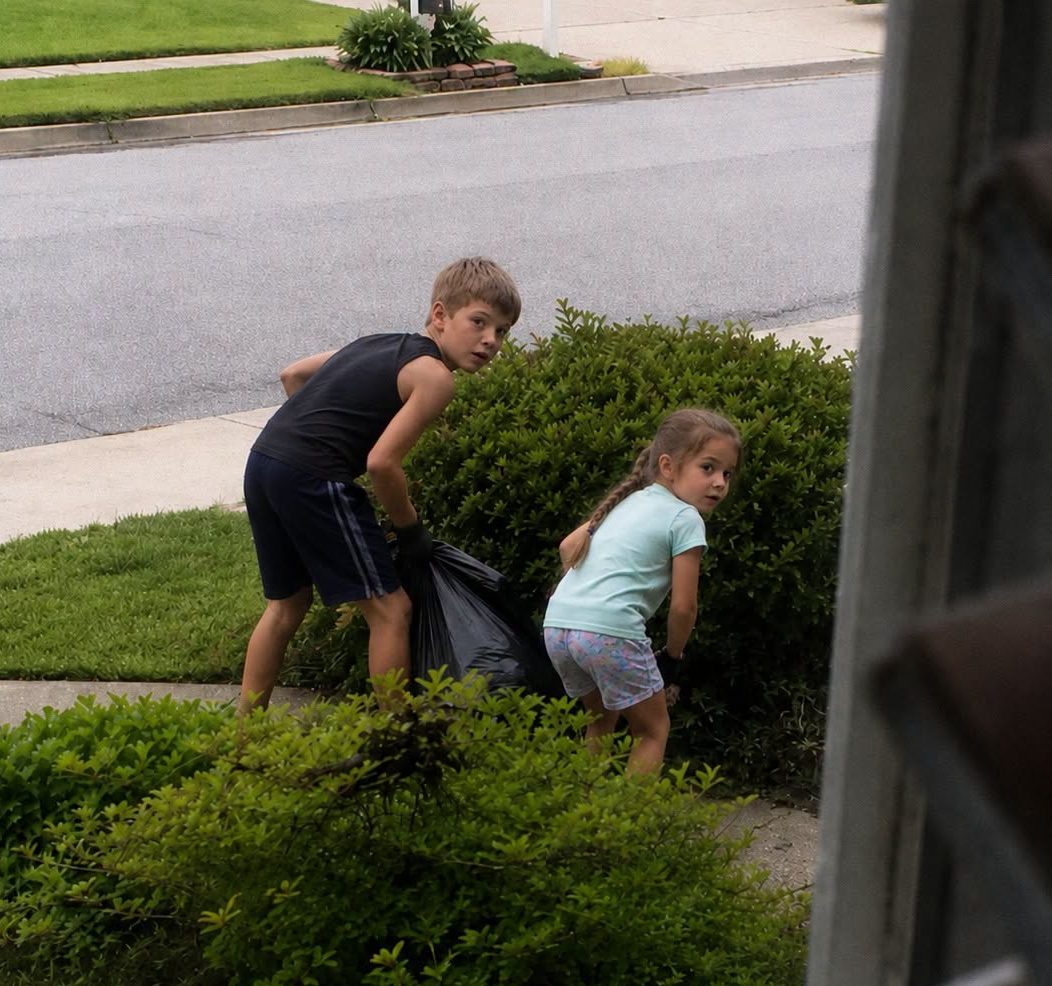
Every Sunday morning, almost without fail, the two children who lived next door walked up and down our street carrying a single black trash bag.
Mia was twelve.
Her younger brother, Ben, was nine.
They picked up soda cans, candy wrappers, discarded receipts, and whatever else the wind had pushed against our fences overnight.
Everyone on the block thought it was wonderful.
“Those children are being raised right,” Mrs. Alvarez once told me.
I agreed.
At least, I thought I did.
Their mother, Laura, had moved into the house beside mine about two years earlier with Mia, Ben, and her husband, Rick Doyle.
Rick was the children’s stepfather, although whenever he was around, they called him Dad.
He worked in home security, installing cameras, alarms, smart locks, and other systems throughout the county.
He was also the kind of man who seemed permanently cheerful.
At neighborhood cookouts, he laughed louder than anyone.
At school fundraisers, he volunteered.
If someone needed advice about a doorbell camera, he was happy to offer it.
But there was one thing about him I never liked.
Whenever Laura spoke in public, Rick often rested one hand against the back of her neck.
It could have looked affectionate.
Some people probably thought it was.
To me, it always seemed as though he was reminding her that he was there.
Still, I never said anything.
Then, one Sunday morning, everything changed.
I was watering the flowers beneath my front window when I noticed something unusual beneath the bushes.
A clear plastic bag.
At first I assumed it was litter the children had missed.
Then I saw what was inside.
A small silver flash drive.
And a folded piece of paper.
I crouched beside the bush and pulled it free.
My name was written across the front.
MRS. CARTER.
For a moment, I simply stared at it.
Earlier that morning, I had seen Ben near those same bushes.
I remembered him glancing toward my house before quickly hurrying after Mia.
My first thought was that perhaps they had left me some kind of thank-you note.
Then I unfolded the paper.
The handwriting was uneven, as though the person holding the pen had been frightened.
It said that if their mother ever disappeared, I should give the flash drive to the police.
It also said two other things.
Do not give it to Rick.
Do not tell Rick they had hidden it there.
The world around me suddenly felt very still.
I looked toward the house next door.
Every curtain was closed.
Rick’s black truck was gone.
Mia and Ben had already disappeared around the corner.
I carried the plastic bag inside, locked my front door, and stood in my kitchen staring at the flash drive.
My first instinct was to call the police.
My second thought stopped me.
What if Rick returned while officers were there?
What if I had misunderstood?
What if calling immediately somehow made things more dangerous for Laura and the children?
Then I read the note once more.
They had not written, If Mom gets hurt.
They had written, If Mom disappears.
That word changed everything.
I pulled an old laptop from a closet, one I rarely used anymore, and plugged in the drive.
Seven folders appeared.
PHOTOS
RECORDINGS
MONEY
RICK’S TRUCK
MOM’S PHONE
DATES
And one more.
READ FIRST
My hands were already trembling when I clicked it.
There was only one video inside.
Mia appeared on the screen.
She was sitting on the floor of what looked like a closet.
Ben sat beside her with his arms wrapped tightly around his knees.
Mia looked directly into the camera.
Her voice was barely above a whisper.
She explained that if anyone was watching the recording, then something had gone terribly wrong.
Then she began talking about Rick.
And within minutes, the family I thought I knew disappeared completely.
Part 2 — The Truth Inside the Drive
Mia said Rick controlled almost everything in their home.
Laura’s money.
Her phone.
Her identification.
Where she went.
Who she spoke to.
When she had once tried to leave, he had tracked them down at Laura’s sister Rachel’s house and brought them back.
As Mia spoke, an old memory surfaced.
There had been a week the previous year when Laura and the children vanished from the neighborhood.
Rick told everyone they were visiting relatives.
When they returned, Laura wore large sunglasses for several days, even though the weather was gray and rainy.
I had thought it was odd.
But odd was easy to ignore when you had no reason to imagine something worse.
In the video, Mia explained that she and Ben had secretly begun documenting what happened inside their home.
They had recorded arguments.
Saved messages.
Photographed things they believed might matter.
Then Ben mentioned a cabin in the woods.
Mia immediately looked uncomfortable.
She explained that Rick had once taken the family there.
Behind the cabin was a large pit.
Rick had used it to frighten Laura, making it clear that terrible “accidents” could happen to people who disobeyed him.
I paused the video.
My kitchen suddenly felt far too small.
For two years, I had lived beside this family.
I had watched Laura collect packages from her porch.
I had given her tomatoes from my garden.
I had waved while she walked Ben to the bus stop.
I knew which flowers she planted every spring.
Yet I knew almost nothing about what happened after her front door closed.
I pressed play again.
Mia continued explaining that Rick’s job gave him knowledge most people did not have.
He knew where cameras were installed.
He knew which roads had limited surveillance.
He knew people in local law enforcement because of his work.
And he often reminded Laura of those things.
The video ended.
I opened the audio recordings next.
There were more than twenty.
In one, Rick mocked Laura for thinking anyone would believe her.
In another, Laura was crying while Rick warned her that if she tried to leave again, the children would suffer too.
Some recordings ended suddenly.
Others contained long stretches of frightening silence.
Then I opened the photographs.
Pictures of injuries Laura had apparently tried to hide.
A lock installed on the outside of a bedroom door.
A firearm photographed inside Rick’s truck.
Several items stored together that made no sense as ordinary household supplies.
And screenshots of messages Rick had sent Laura.
Threats.
Warnings.
Instructions about what she should tell her sister.
The final photograph made my stomach twist.
It showed a handwritten list.
Four names.
Laura.
Mia.
Ben.
Rachel.
A date had been written beside each one.
I stopped hesitating.
I called 911.
Part 3 — The House Next Door
The dispatcher told me to stay inside, avoid contacting Rick, and not approach the children if they returned.
She asked whether Laura was home.
“I don’t know,” I admitted.
“Do you see her car?”
That question stunned me.
Laura did not have a car.
Rick had always told everyone she hated driving.
For the first time, I wondered whether that had ever been her choice.
Two patrol cars arrived quietly a short time later.
No sirens.
No flashing entrance down the street.
A detective named Vasquez came to my house.
I showed her the note.
Then the flash drive.
She watched Mia’s video once.
She did not need to watch it twice.
Her expression changed almost immediately.
She made a call and requested an urgent protective response.
Officers went next door.
No one answered.
Laura’s phone went directly to voicemail.
Then, while we stood listening, someone heard a faint sound from behind the house.
Three taps.
Silence.
Then three more.
An officer hurried around the side.
Several minutes later, he returned with Laura.
She was still wearing pajamas beneath a long cardigan.
She looked exhausted and frightened.
Rick had locked her inside the laundry room before leaving that morning, securing her so she could not easily get out.
She had spent hours making noise whenever she thought someone might be nearby.
Detective Vasquez immediately asked about Mia and Ben.
Laura blinked at her.
“What do you mean?”
“The children. Where are they?”
“Upstairs.”
The detective’s face tightened.
“They aren’t.”
For one terrible second, Laura did not move.
Then the color drained from her face.
She tried to rush toward the stairs, but an officer stopped her gently.
I explained that I had seen Mia and Ben earlier that morning.
They had been walking down the street with their usual trash bag.
Laura stared at me.
Then she whispered the words that made everyone in the room freeze.
“He found out.”
Detective Vasquez stepped closer.
“Found out about what?”
Laura looked at the flash drive in my hand.
“The copies.”
“Copies?”
She began to cry.
That was when we learned the truth about those Sunday walks.
The drive beneath my bush was not the only one.
There were twelve.
Part 4 — What the Children Had Been Doing Every Sunday
For almost three months, Mia and Ben had been hiding copies of their evidence throughout the neighborhood.
One beneath my bushes.
One near Mrs. Alvarez’s mailbox.
Another behind a loose section of stone near Mr. Patel’s garage.
Week by week, house by house, they had spread the evidence across the block.
The black trash bag had simply made their routine look ordinary.
They really did pick up garbage.
Just enough to make anyone watching believe that cleaning the neighborhood was their only purpose.
But each Sunday, they chose another house.
Another hiding place.
Another adult.
I asked Laura why they had made so many copies.
Her answer was simple.
“Because Rick always finds things.”
He checked phones.
He searched rooms.
He monitored the house.
If they had hidden the truth in only one place, he could destroy it.
Mia understood that.
According to Laura, the children chose neighbors they believed were safe.
People who smiled at them.
People who brought food when someone was sick.
People who had visible doorbell cameras.
People who seemed likely to notice when something did not belong.
My house had been first.
“Why me?” I asked.
Laura wiped her eyes.
“Because of the flowerpot.”
I remembered immediately.
The previous summer, Ben had accidentally sent a baseball over the fence.
It struck one of my clay pots and shattered it.
Before I had even noticed, he appeared at my door looking miserable, holding five dollars from his allowance.
I refused the money.
I told him accidents happened.
What mattered was that he had come to tell me the truth.
Laura looked at me.
“He never forgot that.”
Something inside me broke a little.
A nine-year-old boy had decided I was trustworthy because I had not punished him for being honest.
That tiny moment—which I barely remembered—had become part of his emergency plan.
Before I could say anything, Detective Vasquez asked the question that mattered most.
“Where is Rick?”
Laura looked toward the road.
“He said he was taking the kids to breakfast.”
My stomach dropped.
Rick had them.
Within minutes, an alert went out across the county.
Then came a lead.
A traffic camera had captured Rick’s truck traveling north, toward the wooded area where his uncle owned an old hunting cabin.
The same cabin Mia had described.
Laura went pale.
She did not need to say what she was thinking.
Neither did I.
Police told us to remain behind.
There was nothing we could do but wait.
And waiting may have been the hardest part of all.
Part 5 — Two Hours That Felt Like a Lifetime
Laura sat in my living room wrapped in a blanket.
Officers searched her house next door.
I made tea.
Neither of us touched it.
Every few minutes, Laura asked the same question.
“Has anyone called?”
No one had.
Eventually she looked toward my front window.
“The children chose your house first,” she said quietly.
I nodded.
“I still can’t believe that.”
“Ben said you made him feel safe when he told you the truth.”
I looked toward the broken flowerpot’s replacement on my porch.
All morning, I had been thinking about the signs I had missed.
Laura flinching when Rick approached.
Mia watching her stepfather whenever her mother spoke.
The sunglasses.
The strange silences.
Rick’s hand on Laura’s neck.
How many times had I noticed something without understanding what it meant?
Two hours later, Detective Vasquez finally called.
I watched Laura’s face as she listened.
Then her knees nearly gave way.
The children had been found.
Alive.
Police had located Rick’s truck near the cabin before he could take them farther into the property.
Mia had helped them find it.
Rick had an old phone he no longer used.
At some point, he had tossed it into the back seat after replacing it.
Mia managed to reach it and activate its emergency function while Rick was away from the vehicle.
That signal gave police what they needed.
When officers arrived, both children were frightened and shaken, but safe.
Laura leaned into me.
For the first few seconds, she made no sound.
Then everything came out at once.
Months—perhaps years—of fear, silence, and forced calm seemed to break open.
I held her while she cried.
And I realized that sometimes relief can be almost as overwhelming as terror.
Rick was arrested.
Over the following weeks, investigators uncovered far more than anyone in the neighborhood had imagined.
There were charges connected to what he had done to Laura.
Charges involving the children.
Charges involving threats, unlawful confinement, and the attempt to take Mia and Ben away.
Investigators searched the cabin.
They found the pit Mia had described.
Rick insisted it had an innocent purpose.
The police found reasons to doubt that explanation.
They also discovered paperwork and other materials suggesting that Rick had been preparing a false explanation for whatever might eventually happen to Laura.
He had not simply tried to control her life.
He had been preparing to control the story people heard afterward.
That realization stayed with me.
Because the flash drives had ruined that plan.
He could delete one recording.
Confiscate one phone.
Search one bedroom.
But Mia and Ben had made sure the truth existed beyond his reach.
In twelve gardens.
Twelve yards.
Twelve places he did not know about.
For illustrative purposes only
Part 6 — The Street After They Left
Rick eventually received a lengthy prison sentence.
His security business also fell apart after investigators uncovered additional misconduct involving systems he had installed for customers.
The case became bigger than our neighborhood.
But by then, Laura and the children were gone.
A victim-support organization helped move them to temporary housing somewhere outside the county.
For safety reasons, none of us knew exactly where.
The first Sunday after they left felt strangely empty.
A paper cup rolled along the curb.
Wrappers had collected beneath the hedge.
But Mia and Ben did not appear.
There was no black trash bag.
No small figures walking from house to house.
Then Mrs. Alvarez found something beneath her mailbox.
A flash drive.
Mr. Patel found another.
Over the next several days, more neighbors discovered the copies Mia and Ben had hidden.
Each came with essentially the same warning.
If something happened to their mother, give the evidence to police.
People reacted in different ways.
Some cried.
Some became furious.
Others began saying they had always known something was wrong with Rick.
I never said that.
Because I had learned something uncomfortable.
Saying afterward that you “had a feeling” is easy.
Doing something while you are uncertain is much harder.
I had seen Laura’s sunglasses.
I had seen her become quiet around Rick.
I had noticed the way Mia watched him.
I had seen Rick’s hand resting on Laura’s neck.
I noticed those things.
But I had not understood them.
There was a difference.
Still, the difference did not make me feel much better.
Three months later, I received a letter.
There was no return address.
It was from Mia.
She wrote that her mother had an attorney and was receiving support.
Ben was finally sleeping better.
Mia had joined an art class.
Then, near the bottom of the page, she wrote something I have never forgotten.
Laura believed they should have told an adult sooner.
Mia disagreed.
In her mind, they had told adults.
Twelve of us.
We just had to discover what they had left behind.
I sat with that thought for a long time.
Because she was right.
Every Sunday, those children had been asking for help.
Not directly.
Not in a way most adults would recognize immediately.
But through patterns.
Through glances.
Through a trash bag that never seemed completely full.
Through tiny objects hidden in places where someone responsible might eventually notice them.
They had created a message without ever saying it aloud.
And for months, none of us knew we were receiving it.
Part 7 — Look Under the Leaves
The following spring, Laura returned once.
Rick’s house had been sold, and she came back with an escort to collect the last of the family’s belongings.
Mia and Ben came with her.
Word seemed to spread without anyone making a call.
One by one, neighbors stepped outside.
Mrs. Alvarez hugged Laura.
Mr. Patel gave Ben a new baseball glove.
Others simply stood nearby, unsure what to say.
I waited beside the bush beneath my window.
The same bush where I had found the first flash drive.
Mia walked toward me.
She had grown a little taller.
Or perhaps she simply seemed older.
“You opened it,” she said.
“I did.”
She studied me.
“Were you scared?”
“Yes.”
She nodded.
I think she preferred the truth.
Then she looked at the ground.
“I thought maybe you’d throw it away.”
“Why would I do that?”
She shrugged.
“Sometimes adults think kids are just causing trouble.”
I looked at her.
“You weren’t causing trouble.”
“We hid things in people’s yards.”
“You were putting the truth somewhere it couldn’t disappear.”
Mia considered that.
Then she glanced toward Laura.
“Was Mom doing that too?”
I knew what she was asking.
Her mother had hidden things as well.
Fear.
Pain.
Plans.
The desire to leave.
Laura had stayed silent because, in her mind, silence was part of keeping Mia and Ben safe.
I chose my words carefully.
“Your mother was doing what she needed to do to survive,” I said. “All three of you were.”
Mia was quiet for a moment.
Then she reached into her pocket.
She held out a flash drive.
I stared at it.
My chest tightened.
“This one’s empty,” she said.
I took it.
“Why are you giving it to me?”
“So you remember.”
“Remember what?”
She glanced toward the bushes.
“To look under the leaves.”
I closed my hand around the little silver drive.
“I will.”
And I have.
Mia and Ben do not clean our street anymore.
Now we do.
It began with Mrs. Alvarez walking the block one Sunday carrying a trash bag.
Mr. Patel joined her the following week.
Then I did.
Soon there were half a dozen of us.
Then ten.
Now, almost every weekend, neighbors walk the street together.
We collect bottles and wrappers.
We straighten fallen bins.
We check on older residents.
We talk to one another.
But more importantly, we pay attention.
To the houses.
To the people inside them.
To sudden changes.
To unusual silences.
To the small things that do not quite make sense.
Because our street taught us something none of us wanted to learn.
A neighborhood can look peaceful and still hide enormous pain.
A smiling man can frighten the people who live with him.
A quiet mother may be using every bit of strength she has simply to make it through another day.
And children praised for being “responsible” may sometimes be carrying burdens they should never have been asked to carry.
For months, I believed Mia and Ben were collecting garbage.
They weren’t.
Not really.
They were distributing the truth.
One copy at a time.
Because they understood something adults around them had failed to see.
Rick could search their rooms.
He could control phones.
He could destroy files.
He could frighten one person into silence.
But he could not search every garden on the street.
He could not know which neighbor might discover the evidence first.
And he could not silence an entire community once the truth was finally out.
The flash drive beneath my window was tiny.
It weighed almost nothing.
Yet it carried enough truth to change four lives.
And sometimes, when I walk past that bush on Sunday mornings, I still remember the moment I found it beneath the leaves.
The moment two frightened children finally made one adult stop—
and pay attention.